












Pediatric Measurements

Pediatric measurements: length, body weight...etc.
Video Transcript
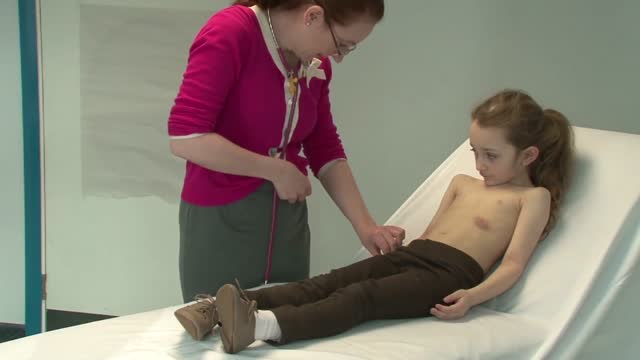
A pediatric teaching lecture on objective measurements: how to take a child's temperature by each route and the normal ranges, head circumference, weighing and length/height measurement, and how the figures are plotted on percentile curves — with the warning that a child crossing percentiles matters more than any single reading. It ends with practical advice on the order and hygiene of the pediatric examination.
Read the full transcript
The objective measurements are easy to determine. These include the child's body temperature, head circumference, weight, and length. Body temperature may be taken rectally, axi-larally, or orally. Rectal temperature is normally between 36.8 and 37.5 degrees Celsius. Temperatures between 37.5 and 38 degrees are defined as a raised temperature, whereas a rectal temperature of over 38 degrees is by definition fever. The normal axi-larity temperature is between 36.2 and 36.8 degrees Celsius, and the oral temperature is between 36.7 and 37.2. Note that the axi-larity temperature is around half a degree lower than the rectal or oral figure.
Body temperature undergoes rhythmic oscillations during the day. Physical activity and digestion raise the temperature slightly. When measuring the head, take the widest occipitofrontal circumference.
Babies are weighed unclothed on a scale pan. The scale pan must be warm so as not to startle the baby. Older children are weighed standing on normal scales. The length of a baby or toddler is determined supine, with a special measuring tool.
In an emergency, two books will do.
Older children are measured in a standing position. The child should be standing upright with its heels, seat, shoulders and occipit against the wall. The child's height is then determined using a sliding marker.
Head circumference, weight and length are entered on to a so-called percentile curve, according to the child's age and sex. Here is a drawing of a percentile curve for boys. Our young patient's height is on the 25th percentile. That means that 25 percent of boys his age are shorter. The 50th percentile is the median value. It corresponds to the apex of a bell curve. The 25th and the 75th percentile correspond more or less to the first standard deviations. The second standard deviations roughly correspond to the third and the 97th percentile.
By definition, we consider all figures outside two standard deviations to be abnormal.
When measuring length and weight, the evolution is more important than a single figure. If we follow up the child's length since his birth, we find that it remains constant on the 10th percentile. If we also take into account the statues of his parents, the rate of growth may well be normal.
Another child's length is also on the 10th percentile. This in itself is not a reason for concern, but if we follow up the child's length from the time when he was born, we find that it used to be among the longest, but has now become one of the shortest for his age. This requires further clarification.
And now for the actual examination.
The doctor must be careful about hygiene. An effective and simple measure is washing and disinfecting the hands before and after the examination. At the same time, the hands can be warmed for the examination.
A young child becomes restless very quickly.
This is why examinations which require him to be quiet are done at the beginning.
While the child is quiet, the heart and lungs are auscultated and the abdomen is palpated.
Examinations which are unpleasant for the child are done at the end. These are autoscopy, pharyngoscopy, rectal examination and ophthalmoscopy.
The whole examination should be done quickly, but without being rushed.
Transcript auto-generated from the video’s audio for accessibility and study. Educational content only — not medical advice.
Video Overview
From our Pediatrics collection: Pediatric videos: child health, newborn care, common childhood illnesses and pediatric procedures explained for parents, students and clinicians. Browse all Pediatrics videos →
SORT BY-
سرفہرست تبصرے
-
تازہ ترین تبصرے