

















Vaginal Child Birth

Labor And Delivery During Vaginal Child Birth
Video Transcript
A narrated animation explaining the three stages of vaginal childbirth: the cervix effacing and dilating in the first stage, pushing and delivery of the baby in the second — including crowning, head molding and the delivery of the shoulders — and delivery of the placenta in the third.
Read the full transcript
During a vaginal childbirth, the first stage of labor lasts about 12 to 19 hours and starts when your baby settles lower into your pelvis. In response, your cervix begins to efface or become thinner and dilate or widen. During this time, you may feel strong regular contractions occurring every 5 to 20 minutes and lower back pain and cramping that doesn't go away. You may see a brownish or reddish mucus discharge which could be the mucus plug at the opening of your cervix falling out. Your water may break which can either be a large gush of fluid or a continuous trickle.
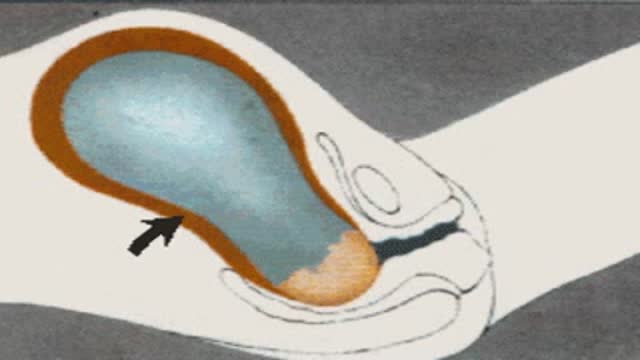
If you experience any of these symptoms, contact your doctor or midwife to see if you should go to the hospital. At the beginning of stage 2 of labor which usually lasts from 20 minutes to 2 hours, your cervix is fully dilated to 10 cm and your baby's head has moved beyond the cervical opening into your birth canal. Your doctor or midwife will instruct you to push during your contractions and rest between them. In a normal delivery, your baby's head will rotate to face your back. During active labor, your uterus is divided into an active segment that contracts, pushing the baby downward,
and a flexible passive segment that remains relaxed, stretching to provide more room for the baby to pass through. When the top of your baby's head appears or crowns, your doctor may make a small cut, called an apesiotomy, to enlarge the vaginal opening. Then your doctor or midwife will give you instructions on how to push your baby out. As your baby's head passes through the birth canal, it molds into an elongated shape. An elongated head shape will resolve itself within a few days as the skull bones shift back into place.
After your baby's head exits the birth canal, his or her head and shoulders will rotate to help the shoulders pass through the birth canal. Your baby's shoulders are delivered one after the other in order to fit through your pelvis. Once the shoulders emerge, the rest of your baby slides out easily. After your baby is born, his or her umbilical cord will be cut. In stage 3 of labor, which may last 5 to 30 minutes, mild contractions will help push the placenta out of the uterus. During this stage, you and your baby may begin bonding through skin-to-skin contact and breastfeeding.
Transcript auto-generated from the video’s audio for accessibility and study. Educational content only — not medical advice.
Video Overview
From our Gynecology collection: Pelvic exams, Pap smears, IUD insertion, hysteroscopy and women's health procedures explained step by step. Browse all Gynecology videos →
SORT BY-
I migliori commenti
-
Ultimi commenti