



Medical Videos - World's First Head Transplant Surgery

Watch that video to know more about the World's First Head Transplant Surgery
Video Transcript
A television news-magazine segment about a proposed — not performed — head transplant. It outlines the plan described by the surgical team (cooling, a diamond blade for the spinal cord, fusing the cords) and interviews the prospective patient about his condition and reasons, and the audio runs on into the start of an unrelated story at the end. Despite the title, no transplant surgery is shown or had taken place.
Read the full transcript
We have the most extraordinary story for you now. Over the past few years, we have seen surgeons carry out the first hand transplant, womb transplant, and of course we've seen face transplants. But now one doctor is planning on making history by performing the world's first ever head transplant. Yep, you heard correctly, a head transplant, the full head. The pioneering is somewhat controversial operation. We'll see the head of Valarys Veridinov, who's terminally ill and wheelchair bound, attached to an entirely new body. We're speaking to Valarys who's here with us in just a moment.
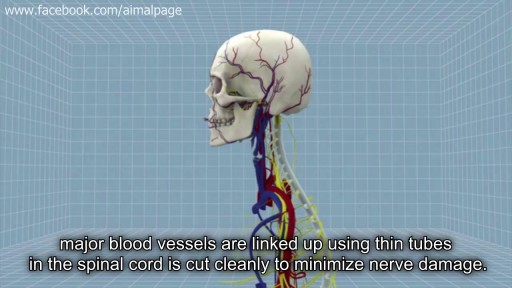
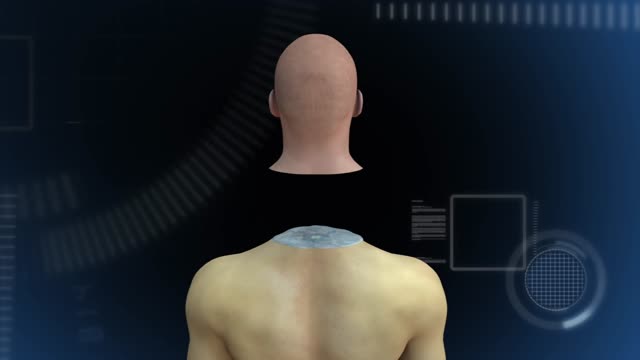
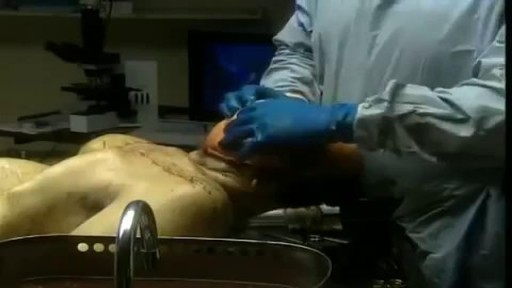
First, Charlotte has more on exactly what this extraordinary procedure will involve. Yes, it really is such a complicated process. When the surgeon planning this operation says it'll take around 150 medical staff, 36 hours to complete. The first step is to freeze the head and body in order to stop the brain cells from dying. The neck will then be cut and the tubes connecting the key arteries and veins fitted. The next step will be the biggest challenge. Now this is cutting the spinal cord and doctors will be using an extremely fine blade
made from diamond to minimize the damage here. The head will then be moved from the donor body and the spinal cords will be fused together using a special type of glue. Now once all that is in place, it is a race against time to reattach all the remaining muscles, veins and the organs like the esophagus. Once the skin is stitched together by a plastic surgeon, the patient will be kept in an induced coma for four weeks to allow everything to heal. It really is an extremely intricate procedure.
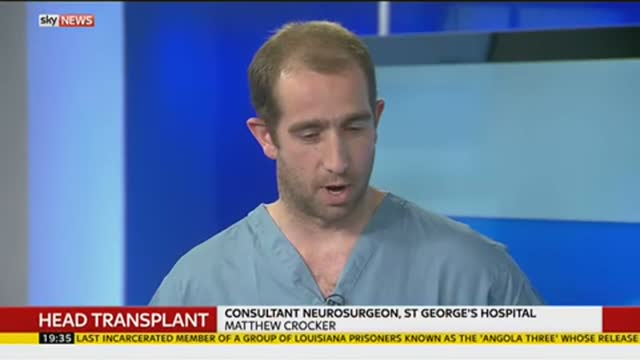
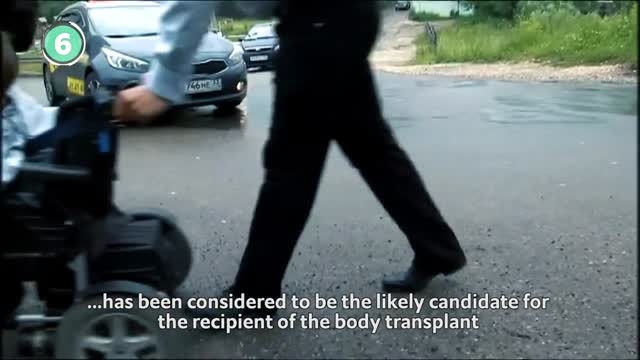
So Valarys Spirodonov wants to undergo that procedure, that surgery. Dr. Hillary is here alongside you. Well Valarys, it's fantastic to meet you and thanks so much for coming in. This is just extraordinary, just hearing the details of this procedure from Charlotte. Tell us why you want to undergo something, I mean frankly, so life-threatening. Okay. As you can see I'm disabled in a pretty heavy condition. But also I'm very fond of science. I dig deeply into this topic of this kind of transplantations for about 20 years. I read about Robert White's experiments with monkeys and Professor Vladimir Demychov's experiments with dogs.
So I thought that if this technology could be improved and could be done safe enough to make the transplant on humans and to make the transplant with the point where the brain will be able to control the new body, it will make sense. And of course we should evolve this procedure and make it happen. Valarys, obviously it's a very dangerous operation. You know that. You're a smart guy, you know the risks involved. Have you just taken a view, you have a terminal illness anyway, your life expectancy is not great,
you have nothing to lose, is that your thinking? And I suppose my second question is, do you know what your quality of life could be if this is all a huge success? Okay, let me explain. I'm not doing only this project, this whole body transplantation project. I'm also in charge of several other projects, but this was the most public one. I also try to improve lives of other people by creating autopilots, wheelchair systems, other accessible devices. But it became so that Dr. Canaveral's project is most known.
You personally Valarys. I'm trying to get inside, well, quite literally your head about this. I want to know what is making you do this, what is your motivation personally? My motivation personally is about improving my own life conditions and to go to the stage where I will be able to take care of myself, where I will be independent from other people. And you believe this operation, if it's successful, if it's completely successful, and there are massive risks that have been done, but if it works, you believe the quality of your life will not only be extended, but could actually be quite reasonable.
We're trying to do our best to make this experiment safe and to make it believable, and we try to do all the research which is needed to be safe, because today my life is pretty tough. I need to invite people to help me every day, even twice a day, because I need someone to take me off my bed and put me to my wheelchair to assist me through the day, so it makes my life pretty dependable from other people. And if there will be a way to change this, I believe it should be tried, used.
It's worth a go, right? That's what you think. All of a sudden the door is open and I knew I was on the side of the road, bleeding a lot. And Ben, you were on the coach, weren't you, because you'd be on the same tour, and you were upstairs. What did you know about Seb and what had happened? Well, I knew nothing. Oh my...
Transcript auto-generated from the video’s audio for accessibility and study. Educational content only — not medical advice.
Video Overview
From our Surgery Videos collection: Surgery videos: watch real operations step by step — general, laparoscopic and specialist surgery performed in the OR, explained for students and surgeons. Browse all Surgery Videos videos →
SORT BY-
Melhores Comentários
-
Últimos Comentários