
- Physical Examination
- Surgical Examination
- Ophthalmology
- Clinical Skills
- Orthopedics
- Surgery Videos
- Laparoscopy
- Pediatrics
- Funny Videos
- Cardiothoracic Surgery
- Nursing Videos
- Plastic Surgery
- Otorhinolaryngology
- Histology and Histopathology
- Neurosurgery
- Dermatology
- Pediatric Surgery
- Urology
- Dentistry
- Oncology and Cancers
- Anatomy Videos
- Health and Fitness
- Radiology
- Anaesthesia
- Physical Therapy
- Pharmacology
- Interventional Radiology
- Cardiology
- Endocrinology
- Gynecology
- Emergency Medicine
- Psychiatry and Psychology
- Childbirth Videos
- General Medical Videos
- Nephrology
- Physiology
- Diet and Food Health
- Diabetes Mellitus
- Neurology
- Women Health
- Osteoporosis
- Gastroenterology
- Pulmonology
- Hematology
- Rheumatology
- Toxicology
- Nuclear Medicine
- Infectious Diseases
- Vascular Disease
- Reproductive Health
- Burns and Wound Healing
- Kidney Zone Podcast
- Other








Testicular Cancer Self Exam

Educational only: videos on MedicalVideos.com are for general information and are not medical advice. Always consult your own doctor about your health.
This video demonstrates the testicular self-examination, a simple check used to detect lumps or changes in the testicles. Regular self-examination supports early detection of testicular cancer, and the recording shows how the check is performed step by step. Testicular cancer mainly affects younger and middle-aged men, which makes regular self-checks worthwhile.
This video in 30 seconds
A public-information film on testicular self-examination and testicular cancer. The narrator explains signs that should prompt attention, demonstrates the monthly self-exam in the bath or shower, and walks through what happens next, including seeing a doctor, referral and an ultrasound scan.
Key points
- Signs such as a painless lump, enlargement or heaviness are described
- Normal structures such as the epididymis are distinguished from lumps
- A monthly self-exam in the bath or shower is demonstrated
- Examining each testicle between thumb and fingers is shown
- Seeing a doctor and having an ultrasound scan are walked through
Chapters
- 0:00 — Signs and symptoms to notice
- 1:05 — Knowing normal anatomy first
- 1:46 — Monthly exam in bath or shower
- 2:35 — Examining each testicle
- 3:33 — Doctor visit and ultrasound scan
Video Transcript
A classic public-information film on testicular self-examination and testicular cancer. The narrator explains the symptoms that should prompt attention — usually a painless lump, enlargement, or heaviness rather than pain — demonstrates the monthly self-exam in the bath or shower, and walks through what happens next: seeing a doctor, referral to a specialist, and an ultrasound scan.
Read the full transcript
Most cases of this disease appear between the ages of 15 and 40. Well, what might make you think there was something wrong?
Perhaps the first thing you would notice was a slight enlargement of one of the testicles. Possibly it would feel firmer or heavier, or you might actually feel a lump. One of the traps with early cancer is that it's not painful. Only about one in ten patients with testicular cancer experiences acute pain in the testicle. However, there's often a dragging sensation or heaviness in the scrotum or bag, or a dull ache in the lower abdomen or groin. Sometimes a blow or a knock to the testicle makes it ache,
and this leads to the discovery of the lump. Occasionally fluid appears in the sacs around in the testicle, and in this case the swelling called a hydrosilm. It's usually rapidly noticeable, but again, painless. However, very few hydrosilms are caused by malignant tumors.
It's not unmanly or immoral to examine yourself. You need to get to know your own anatomy, so you will notice any changes. You will find out that your scrotum contains other tissues, for example this structure, the epididymis. This collects the sperm from the testicle, so they can travel up the cord towards the prostate gland, and eventually to the outside of the body. So if you haven't examined yourself before, and you find such normal structures, which may feel like lumps to you, don't panic. Remember, you're feeling for a lump in the testicle itself,
or a changing size rather than the structures that normally surround it. We suggest that you examine yourself about once a month. The best time to do this is when you're having a bath or taking a shower, or shortly after, when you're nicely relaxed, and the skin of the scrotum is loose. Otherwise, you won't be able to feel properly. Also, using wet hands increases the sensitivity of the fingers. So that you'll be able to examine yourself properly, we're now going to show you a man demonstrating the technique of testicular self-examination.
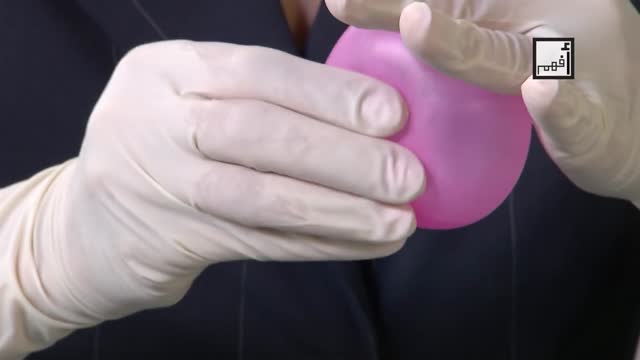
As you can see, he's holding the testicles and scrotum in the palm of his hand, comparing one side with the other for equal heaviness. When you first do this, you may find that one testicle is in fact larger than the other. This isn't unusual. Remember, the reason for examining regularly is to detect any change. Now examine first the one testicle and then the other. Using both hands, gently roll each testicle between the thumb and fingers. It might be helpful, first of all, to locate the epididymis behind and above the testicle,
but do this gently because it's rather tender. Use gentle pressure during the examination if there's any pain, then you're pressing too hard. Check for any small lumps, slight enlargement, or a change in the firmness of the testicle.
Now repeat the procedure on the opposite side. So you see, it's quite simple. It only takes a minute, and if you were to get into the habit of doing this once a month, then you'd be likely to pick up any small change that might mean a cancer. So that's what you should do regularly, but what would happen if you did find something wrong? Well, the first thing to do is to see your own doctor straight away. It's important at this stage that you're not frightened or put off from going.
After all, it probably won't be a cancer. You must overcome any embarrassment. I'm sure your doctor won't mind in the least talking to you about it. When he sees you, he'll probably want to examine your testicles in much the same way as we've shown. If your doctor does think there's something wrong, he'll send you to see a specialist at the hospital who will arrange a few simple tests. He may wish to get an ultrasound test done. This can detect small tumors, but it's also very useful to look for more common things like cysts,
collections of fluid, swellings, and infections. As you can see, the doctor is using a probe which emits sound waves. This is gently rubbed against the scrotal wall which has been smeared with a jelly to allow the sound to penetrate and to look inside the scrotum. The test is not at all uncomfortable and it's a very effective way of deciding whether or not a lump is a tumor. Well, if you look across this is the testicle on the right-hand side. You can see the oval thing. We move across to the left-hand side.
This is the testicle, the lining, down here are some of the tubes. Everything looks okay.
Transcript auto-generated from the video’s audio for accessibility and study. Educational content only — not medical advice.
Video Overview
From our Physical Examination collection: Watch physical examination videos step by step — cardiovascular, respiratory, abdominal and neurological exams demonstrated for medical students and clinicians. Browse all Physical Examination videos →
SORT BY-
Top Comments
-
Latest comments