
- Physical Examination
- Surgical Examination
- Ophthalmology
- Clinical Skills
- Orthopedics
- Surgery Videos
- Laparoscopy
- Pediatrics
- Funny Videos
- Cardiothoracic Surgery
- Nursing Videos
- Plastic Surgery
- Otorhinolaryngology
- Histology and Histopathology
- Neurosurgery
- Dermatology
- Pediatric Surgery
- Urology
- Dentistry
- Oncology and Cancers
- Anatomy Videos
- Health and Fitness
- Radiology
- Anaesthesia
- Physical Therapy
- Pharmacology
- Interventional Radiology
- Cardiology
- Endocrinology
- Gynecology
- Emergency Medicine
- Psychiatry and Psychology
- Childbirth Videos
- General Medical Videos
- Nephrology
- Physiology
- Diet and Food Health
- Diabetes Mellitus
- Neurology
- Women Health
- Osteoporosis
- Gastroenterology
- Pulmonology
- Hematology
- Rheumatology
- Toxicology
- Nuclear Medicine
- Infectious Diseases
- Vascular Disease
- Reproductive Health
- Burns and Wound Healing
- Kidney Zone Podcast
- Other
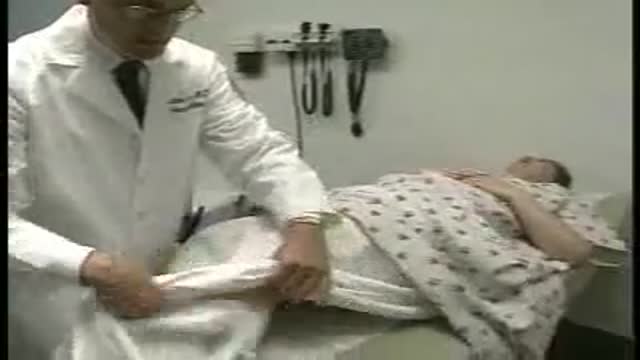



Loyola Female Exam Part 2

Educational only: videos on MedicalVideos.com are for general information and are not medical advice. Always consult your own doctor about your health.
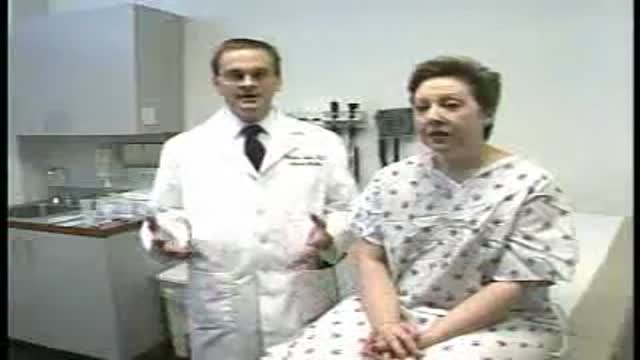
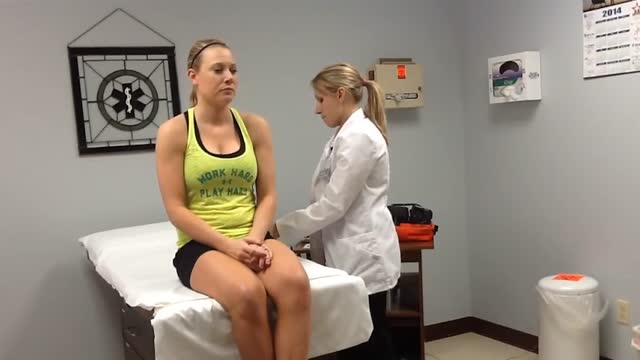
Full examination of the female from head to toe by Loyola Medical School, Chicago. Part 2
This video in 30 seconds
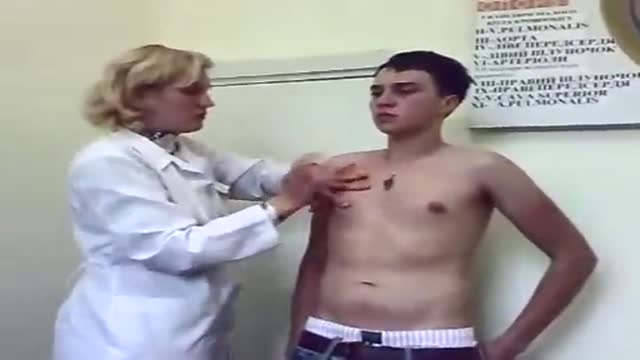
Part 2 of a medical school head-to-toe female examination covers the shoulders and neck, including palpation and range of motion. The examiner then palpates the salivary glands, lymph nodes and thyroid, inspects the spine, and finishes with percussion, fremitus and auscultation of the lungs.
Key points
- Shoulder palpation and range of motion are demonstrated
- Neck range of motion is assessed
- Salivary glands and head and neck lymph nodes are palpated
- The trachea and thyroid gland are examined while the patient swallows
- Lung percussion, fremitus and auscultation are performed
Chapters
- 0:00 — Shoulder and neck palpation
- 0:42 — Shoulder range of motion
- 1:37 — Salivary glands examination
- 2:10 — Lymph nodes of head and neck
- 3:01 — Thyroid and trachea examination
- 3:46 — Spine inspection and lung examination
- 5:33 — Fremitus and lung auscultation
Video Transcript
Part 2 of the Loyola medical-school head-to-toe female examination. This part covers the shoulders and neck — palpation and range of motion — then the salivary glands, lymph nodes and thyroid, and finishes with percussion, fremitus and auscultation of the lungs. The pelvic examination itself is not in this part.
Read the full transcript
Next part of the exam I'm going to move to is the shoulders and the neck examination. I'm going to move your gown forward just a bit and just want to palpate different parts of your shoulder including the coracoid process, roll over the biceps tendon. Is any of this hurt? No, it does not. Okay, let me just palpate over the clavicle here too. You not hurt? No. This side? Nope. No. And same thing, just lift up your sleeve a bit. I'm going to be palpating your left arm to the side, palpating over the biceps tendon,
the coracoid process, and fall over the ac joint. No pain? No. Good. And the next thing I like to do is to check the range of motion of your shoulders. So could you put with your arms straight at your side slowly, make an arc and go with your arms above your head? Good. Now can you put your hands behind your head? Good. Next thing I want you to do is to put your hands behind your back with your fingers all the way up as high as you can.
Great. So the internal, external, you can relax your arms. The internal, external rotation of the shoulders appears to be normal. Next thing I'm going to check the neck range of motion. And there's of course three different positions to check for this. So Nancy, could you touch your chin to your chest? Good. Then all the way back, look up towards the ceiling. Good. Straighten your head out. And touch your chin over towards your shoulder. Good. Now the other side. You'll notice she's not lifting up her shoulder to do that.
Good. Now just tilt your head towards one shoulder, now tilt it towards the other. Good. So the range of motion in the neck appears completely normal too. What I'm going to do next is come behind Nancy. And I'm going to do is palpate for the first of all the parotid salivary glands here. And if there was any, if there was mumps, these are the glands that are getting inflamed. And also palpate for the submandibular salivary glands there too. Good. And they don't seem to have any lumps or abnormalities.
And next I'm going to palpate for the various lymph nodes that could be present around the head and neck. So first we're going to palpate for the pre-aricular lymph nodes, the posterior acular lymph nodes, the submental lymph nodes, submandibular anterior cervical and posterior cervical are in the anterior or the trapezius muscle. I'm going to feel for the superclavicular lymph nodes. And could you lift your shoulders up a bit Nancy? Good. And then finally I'm also going to feel for the occipital lymph nodes. Good. And I don't feel any enlarged lymph nodes in any of those regions.
Next part of the exam I'm going to do is to check for the trachea, which is your wind pipe. So just looking straight across the room, Nancy, I'm just going to put my fingers the bottom of your throat. And I can feel the trachea move back and forth easily between my fingers. So it is midline. Next part of the exam I'm going to do is check for your thyroid gland, which is a little butterfly shaped gland that sits at the base of the neck here. To help me do that I've got a cup of water here.
The answer I'll ask you to do is to take a sip of water but hold it in your mouth while I get my hands in position here. I'm going to feel for the thyroid cartilage which is here and below it is cricoid cartilage, the first rim of cartilage below that. And put my fingers lateral to that. And now can you swallow Nancy? Okay. And I didn't feel your thyroid there. One more sip of water and move my fingers a little bit lower. Do the same thing against fall.
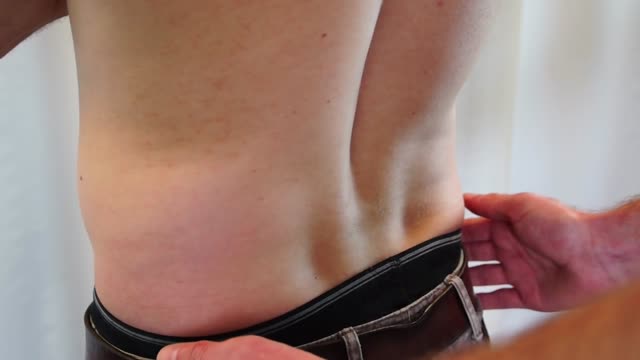
Good. I don't feel your thyroid to be in large or any nodularity to it. So that's good. And next we're going to do is to inspect your spine. That's what I need to ask you Nancy is to sort of turn to the side. And could you undo your top down there? So what I'm doing here is just to look at the spine itself and just gently palpating here I can see that the spine is straight. I see there's no overlying rash or abnormality. I also see that there's no scars on the back also.
I'm going to ask Nancy to take a couple of deeper breaths. I'm just checking your chest wall to see how your chest wall moves during normal breathing. So a few deeper breaths. Good. Again. And there appears to be normal respiration. I'm just going to put my hands around your lower rib cage here. And again ask you to take a deep breath. Exhale. Again. And notice that folded tissue come and go with each respiration which is normal. So again that's appropriate respiratory motion there. Next thing I'm going to do is percussal lung.
So Nancy could you grab your shoulders? That actually kind of helps to separate the scapula. But there's more exposable lung field to percuss. Of course I'm going to start at the top. Good. I'm going to do one area in front here too. Put your arms down for this actually. Good. So it appears to be normal percussion. I percussed three areas in back, one on the side and one in front. Next I'm going to check for Fremitus. Nancy each time I move my hands can you see 99?
99. Good. And what I was checking for is a sense of vibration along my lateral hand there. It was symmetric on both sides as I checked. Next I'm going to do is to listen to the lungs. And again Nancy could you grab your shoulders again? I'm going to ask you to take some breaths in and out through your mouth. Again I'm just going to listen anteriorly in one spot here too. Good. And it all sounds normal.
Transcript auto-generated from the video’s audio for accessibility and study. Educational content only — not medical advice.
Video Overview
From our Gynecology collection: Pelvic exams, Pap smears, IUD insertion, hysteroscopy and women's health procedures explained step by step. Browse all Gynecology videos →
Medical Videos
Free medical and surgery videos for patients, students and professionals — trusted since 2007.
Founded by Dr. Mohamed Ibrahim, MD, PhD — physician-scientist.
Follow us on Facebook · Instagram
SORT BY-
Top Comments
-
Latest comments