
- Physical Examination
- Surgical Examination
- Ophthalmology
- Clinical Skills
- Orthopedics
- Surgery Videos
- Laparoscopy
- Pediatrics
- Funny Videos
- Cardiothoracic Surgery
- Nursing Videos
- Plastic Surgery
- Otorhinolaryngology
- Histology and Histopathology
- Neurosurgery
- Dermatology
- Pediatric Surgery
- Urology
- Dentistry
- Oncology and Cancers
- Anatomy Videos
- Health and Fitness
- Radiology
- Anaesthesia
- Physical Therapy
- Pharmacology
- Interventional Radiology
- Cardiology
- Endocrinology
- Gynecology
- Emergency Medicine
- Psychiatry and Psychology
- Childbirth Videos
- General Medical Videos
- Nephrology
- Physiology
- Diet and Food Health
- Diabetes Mellitus
- Neurology
- Women Health
- Osteoporosis
- Gastroenterology
- Pulmonology
- Hematology
- Rheumatology
- Toxicology
- Nuclear Medicine
- Infectious Diseases
- Vascular Disease
- Reproductive Health
- Burns and Wound Healing
- Kidney Zone Podcast
- Other

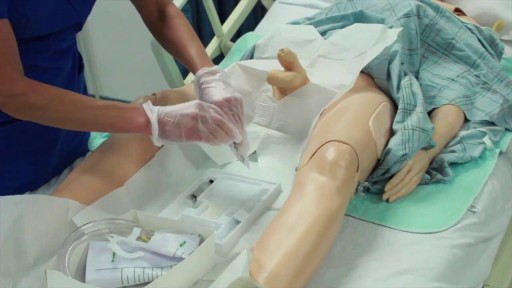





Male Foley Catheter Insertion Procedure

Educational only: videos on MedicalVideos.com are for general information and are not medical advice. Always consult your own doctor about your health.
Step by step, this demonstration covers male Foley catheter insertion, from sterile preparation and draping to advancing the catheter and securing it once urine flows. It is a practical skills resource for nursing and medical students. Procedure education only — not personal medical advice.
This video in 30 seconds
A formal teaching video from Dalhousie University Faculty of Medicine demonstrating male Foley catheter insertion for a patient with urinary retention. The narrator covers hand hygiene, universal precautions and consent first, then demonstrates sterile tray setup, draping, cleansing, catheter advancement until urine flows, securing, and finally catheter removal.
Key points
- The video opens with handwashing, protective eyewear and gloves, and a note that details vary between institutions
- The clinician explains the procedure, possible discomfort and the risk of bladder infection to the patient before starting
- The catheterization tray is opened and arranged on a sterile field, and the catheter balloon is checked
- The clinician drapes the patient, cleanses the area with antiseptic swabs and instils lubricant before advancing the catheter
- Once urine flows, the drainage bag is connected, the catheter is taped in place, and removal is demonstrated at the end
Chapters
- 0:01 — Introduction and safety precautions
- 0:44 — Patient case of urinary retention
- 1:23 — Explaining procedure and consent
- 3:07 — Equipment and catheter tray overview
- 3:56 — Setting up the sterile field
- 8:17 — Draping the patient
- 10:13 — Lubrication and catheter insertion
- 11:57 — Securing the catheter
Video Transcript
A formal teaching video of male Foley catheter insertion produced by Dalhousie University's Faculty of Medicine (Common Currency Project). It opens with the ground rules — handwashing, universal precautions including protective eyewear and gloves, and a note that details vary between institutions — then introduces the patient case and demonstrates the full procedure from sterile preparation and draping to advancing the catheter and securing it once urine flows.
Read the full transcript
This is a video of the urinary catheterization procedure produced as part of the Common Currency Project at the Dalhousie University Faculty of Medicine. There may be slight variation in the procedure from institution to institution depending on policy and equipment used. Before beginning any procedure, be sure to wash your hands properly using the accepted technique and follow all applicable universal precautions. In this procedure, universal precautions involve protective eyewear and gloves. Mr. John Foley, a 67-year-old male, was admitted to the emergency department a few minutes ago with complaint of urinary retention for the past 10 hours.
He is very uncomfortable. The history has been taken. Mr. Foley states this has never happened to him before. He has no previous hospital admissions and denies any drug allergies. A staff physician has seen Mr. Foley and discussed the implications of this procedure with him. Good morning, Mr. Foley. My name is Debbie. I'm a nurse here in the emergency department. I understand you've come in this morning because you're unable to urinate. The best way for us to help you with this problem is to insert a tube called a catheter
up through your penis and into your bladder. This will allow the urine to drain into a bag that will attach to the end of your bed. The procedure might be a little bit uncomfortable, but it shouldn't be painful. Once we get the catheter in, the urine will drain out, and you'll probably feel more comfortable and we can investigate why this problem occurred in the first place. After I'm done the procedure, there may be a little bit of bleeding at the tip of your penis. This is from the trauma of the insertion of the catheter,
and it's a normal occurrence. Every medical procedure has some complications, and this one is no different. The thing we worry about with a catheter insertion is a bladder infection. So if you should develop a fever or chills or just generally not feeling well, be short while I know so we can investigate this. With your permission, I'd like to go ahead with this procedure. Go ahead. Do you have any questions before I start? No. Prepare yourself for the procedure by taking off all excess jewelry, such as rings and watches,
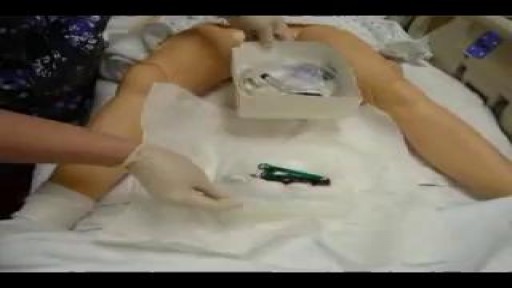
rolling up your sleeves, and if you have long hair, make sure it is tied back and off of your face. You are now ready to wash your hands. After washing your hands, prepare the patient by having him lie flat on the stretcher on his back, with his legs slightly abducted at the hips, exposing his genitalia. This way, when you are wearing sterile gloves, you can avoid contamination by not touching the bed linens. Ensure you respect the patient's dignity. On a standard table next to your dominant hand,
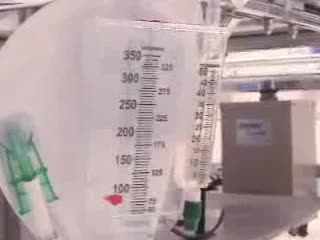
arrange the equipment required for the procedure. The equipment includes a catheterization tray, some tape, a pre-filled 10cc syringe of 2% xylokane jelly as an anesthetic and lubricant, an appropriately sized two-way indwelling foley catheter, a urinary drainage bag, and protective goggles for universal precautions. Open the urinary drainage bag, hook it onto the end of the bed and put all the tubing on the end of the bed within reach, leaving the protective cover on the end of the tubing to avoid contamination. Put the protective goggles on. Tear the bag of the catheter tray open
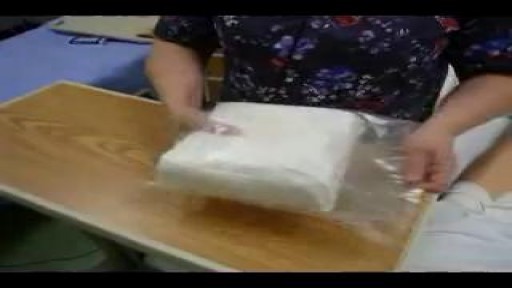
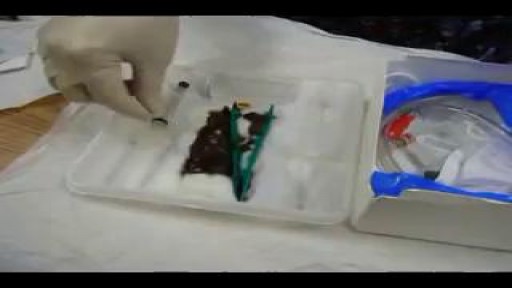
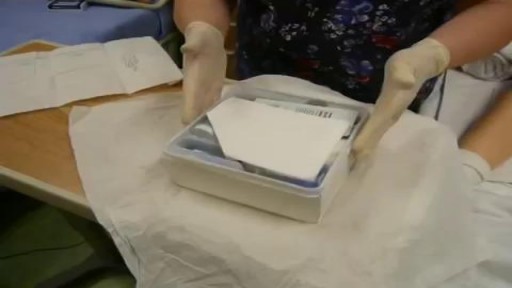
and discard the bag. Open the foley catheter tray, remembering that all sterile trays must be opened in the proper manner. The first step is to make the initial opening of the wrap away from you. Open one end of the wrap to the right, the other to the left. Now reach under the last flap, removing the sterile forceps, remembering to grasp them by the handle and avoid touching the sterile tips. Open the last flap of the wrap toward you. By opening the tray in the appropriate way, you will not contaminate the sterile field
by repeatedly reaching across it. Using your sterile forceps, remove the first drape, sterile gloves, and the second drape. Continue taking things out of the graduated basin, which is the container used as a urine receptacle. Be sure to visualize that everything needed to complete the procedure is in the basin. Place each item so it is easily accessible and easy to complete as needed. Before donning sterile gloves, open the foley catheter in sterile fashion and place the catheter on the sterile field. Discard the first set of forceps into the garbage can.
Open the xylokane jelly syringe and place it on the tray in a sterile fashion. Discard the wrap. Prepare to put on the sterile gloves which are on the tray and easily accessible. Use a spacer cuff to pick up the first sterile glove from the inside with one hand. Be careful not to touch the outside of it. Next, scoop underneath the cuff of the second glove, sliding it onto your ungloved hand. Now having sterile gloves in place, adjust them so they fit comfortably. With sterile gloves on, it is safe to touch anything on the sterile field.
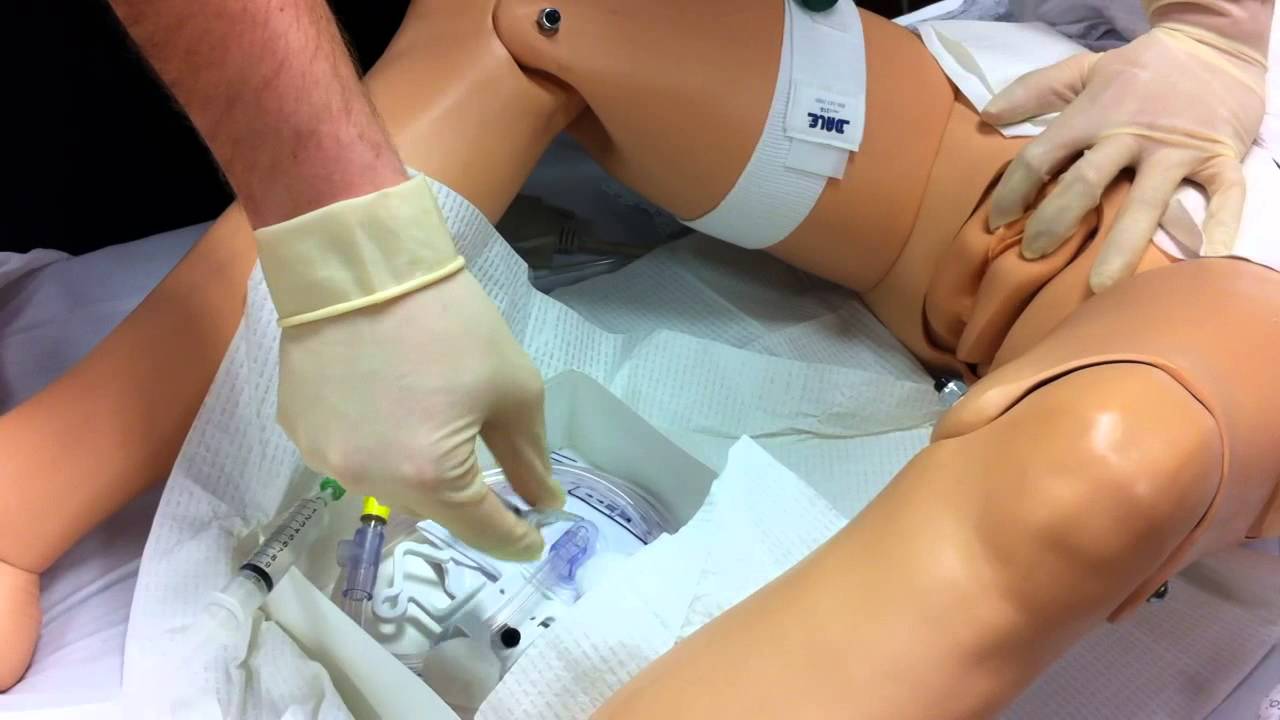
Remove the catheter from the sterile wrapper, placing it on the sterile field and discarding the wrapper. With respect to the catheter, local hospital policy as well as the recommendation of the supplier is to check the patency of the catheter balloon by inflating it using the pre-filled syringe from the tray. If the balloon inflates, make sure it will also deflate. When this is done successfully, put the syringe to the side. Note that two urologists consulted on this procedure do not consider this step necessary, given the quality of currently supplied foley catheters.
They also note that it could potentially cause problems when the balloon does not collapse entirely and bunches around the end of the catheter, creating problems when inserting. Please follow the policy and practice of your own institution. Open the water-soluble lubricant. Lubricate the tip of the catheter approximately two centimeters down from the tip. Prepare the xylokane jelly syringe by connecting the two pieces. Open the povidine iodine. Take the cotton swabs out of the container on the tray and pour the iodine into the container. The catheter tray is now completely set up.
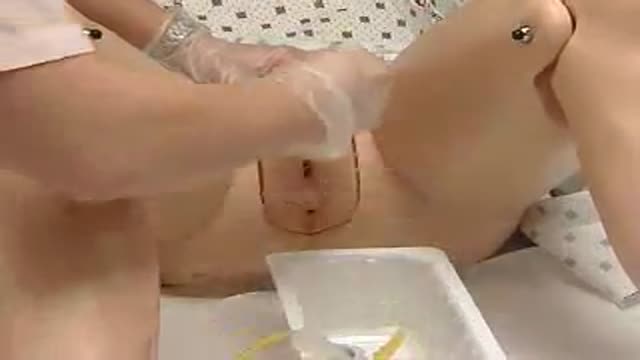
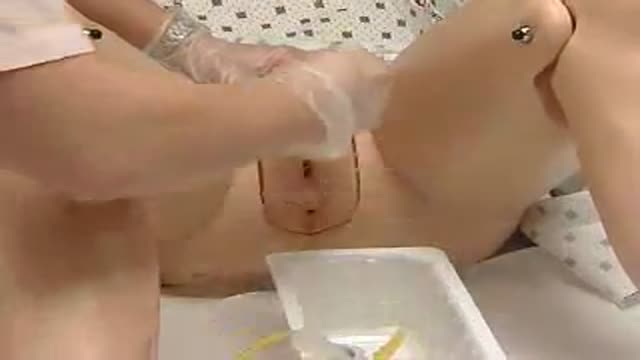
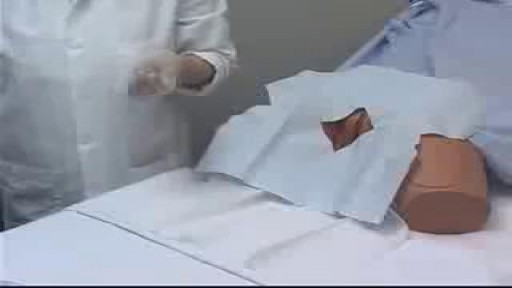
There are two drapes on the tray. The first one is a plain squared drape, which has a dull side and a shiny side, indicating it is waterproof. Unfold the drape, remembering not to shake it open. Slide the drape, waterproof side down, in between the legs of your patient, creating a sterile field. The second drape is a fenestrated drape with the opening in the middle. It also has openings on the side. Again, unfold the drape, don't shake. Use this drape to cover the pubic area, and the opening allows you to expose the patient's penis.
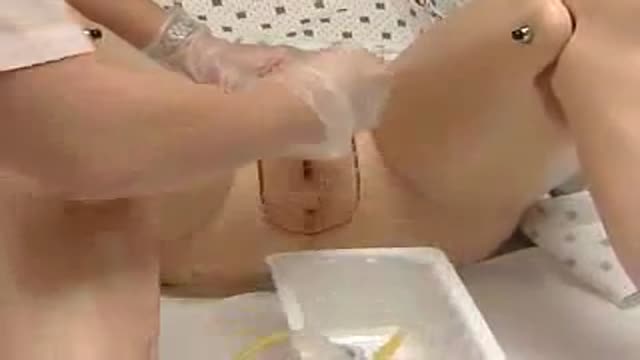
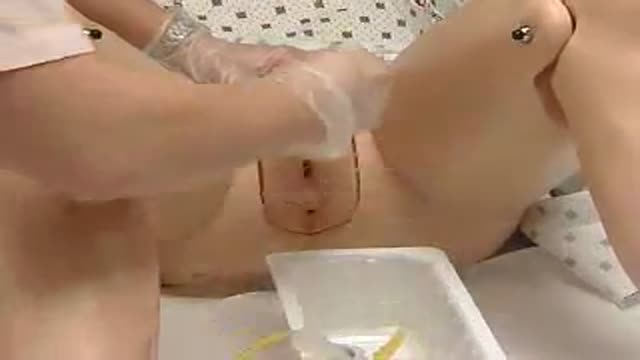
Place the arm receptacle on the sterile drape between the patient's legs. The next step is to clean around the urethral opening before the foley catheter is inserted. With your non-dominant hand, firmly but politely, grasp the penis pointing it towards the sky. This straightens out the urethra, making the procedure more comfortable for the patient. This hand is no longer sterile and cannot return to the sterile field or tray. If the patient is circumcised, it is easy to view the urethral opening. If the patient is uncircumcised, gently retract the foreskin,
exposing the urethral opening. Using your sterile gloved hand, cleanse the gland's penis, starting at the urethral meiatus and circling outwards, including the distal shaft of the penis. Repeat this twice, each time with a clean swab, discarding used swabs away from the sterile field. If you plan to use the 2% zollocane jelly, place the injector tip inside the urethral meiatus and inject slowly. Gently press the catheter in your sterile hand, hold it about 2 cm from the tip, and if you wish, coil the rest in your hand.
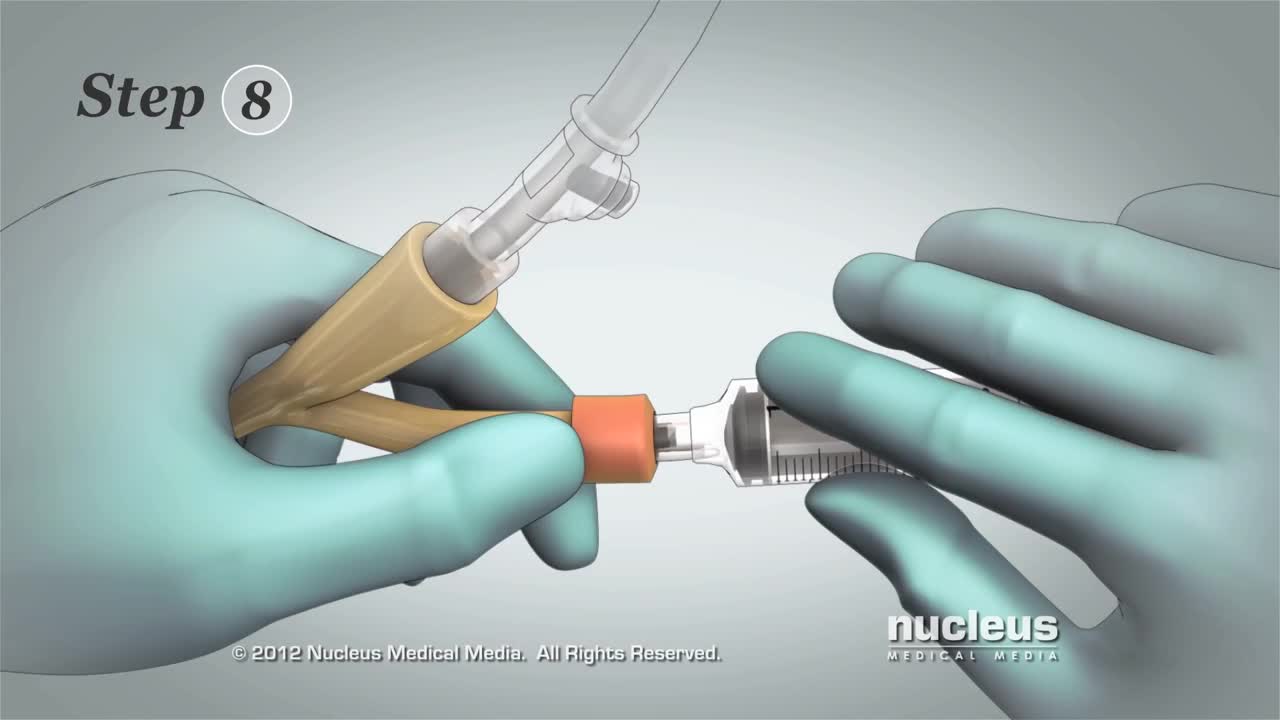
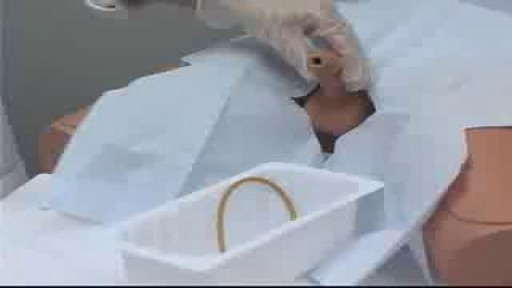
Ask the patient to take some slow deep breaths in a note. Gently insert the folly catheter all the way to the flange or flared tip. If you meet resistance, gently try again, never forcing. Inflate the balloon with the sterile water from the pre-filled syringe in the amount indicated on the catheter port. Do not use saline as it may crystallize over time, making it impossible to deflate the balloon when the catheter is removed. Gently pull back the catheter until resistance is felt, indicating the catheter is abutting the bladder neck.
Yarn should now flow freely through the catheter. Remove the protective cap from the drainage bag tubing. Connect the catheter to the drainage bag and remove the tray and drape from the bed. Dispose of these items appropriately. Using a cloth, wash the povidine iodine solution off the tip of the penis, being sure to replace the foreskin if need be. Take your gloves off and then using a piece of tape, secure the catheter to the patient's inner thigh. Cover the patient so he is warm and comfortable. Mr. Foley, you should be feeling more comfortable now.
Do you have any other questions? No. I'll be back to see you in a while. To remove the catheter, you will need an appropriately sized syringe, an incontinent pad in which to wrap up the catheter, and non-sterile gloves. Remember to leave the catheter connected to the drainage bag before you remove it, but remove the tape. Place the incontinent pad on the bed between the patient's legs. On your non-sterile gloves, attach the syringe into the catheter port. Draw back gently until the amount of sterile water indicated on the catheter port
has been removed. Tell the patient you are ready to remove the catheter. Use a gentle continuous pull to remove the catheter. Dispose of all contents appropriately.
Transcript auto-generated from the video’s audio for accessibility and study. Educational content only — not medical advice.
Video Overview
From our Clinical Skills collection: Suturing, injections, catheterization, IV insertion and OSCE-style examination techniques demonstrated step by step. Browse all Clinical Skills videos →
Medical Videos
Free medical and surgery videos for patients, students and professionals — trusted since 2007.
Founded by Dr. Mohamed Ibrahim, MD, PhD — physician-scientist.
Follow us on Facebook · Instagram
SORT BY-
Top Comments
-
Latest comments