
- Physical Examination
- Surgical Examination
- Ophthalmology
- Clinical Skills
- Orthopedics
- Surgery Videos
- Laparoscopy
- Pediatrics
- Funny Videos
- Cardiothoracic Surgery
- Nursing Videos
- Plastic Surgery
- Otorhinolaryngology
- Histology and Histopathology
- Neurosurgery
- Dermatology
- Pediatric Surgery
- Urology
- Dentistry
- Oncology and Cancers
- Anatomy Videos
- Health and Fitness
- Radiology
- Anaesthesia
- Physical Therapy
- Pharmacology
- Interventional Radiology
- Cardiology
- Endocrinology
- Gynecology
- Emergency Medicine
- Psychiatry and Psychology
- Childbirth Videos
- General Medical Videos
- Nephrology
- Physiology
- Diet and Food Health
- Diabetes Mellitus
- Neurology
- Women Health
- Osteoporosis
- Gastroenterology
- Pulmonology
- Hematology
- Rheumatology
- Toxicology
- Nuclear Medicine
- Infectious Diseases
- Vascular Disease
- Reproductive Health
- Burns and Wound Healing
- Kidney Zone Podcast
- Other
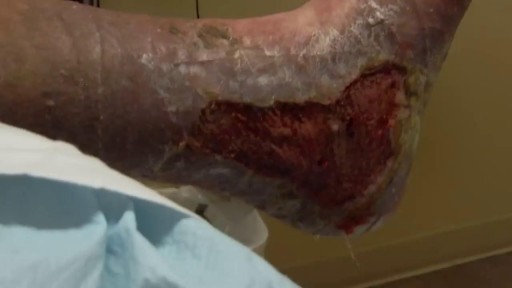
Eschar Removal

Educational only: videos on MedicalVideos.com are for general information and are not medical advice. Always consult your own doctor about your health.
Treatment may not be needed for an eschar if it is part of the natural healing process. However, if an eschar looks like it may have a wound infection – symptoms can include oozing fluid such as pus or blood, your clinician will likely recommend topical treatment or debridement to help control and remove the infection.
This video in 30 seconds
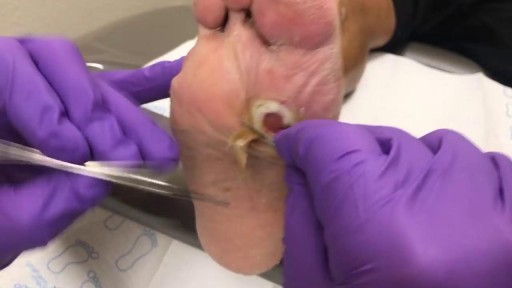
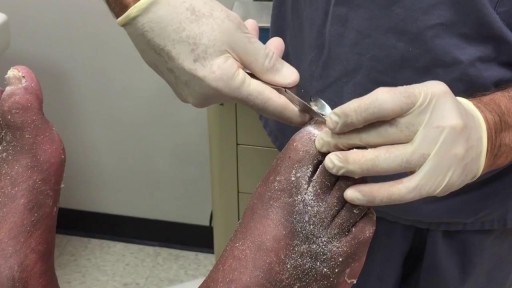
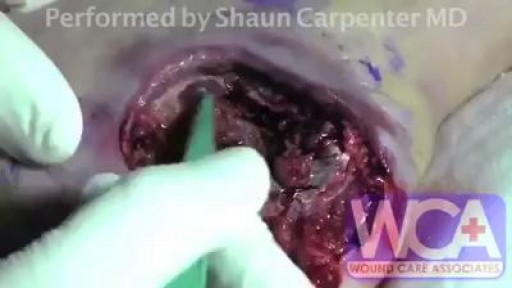
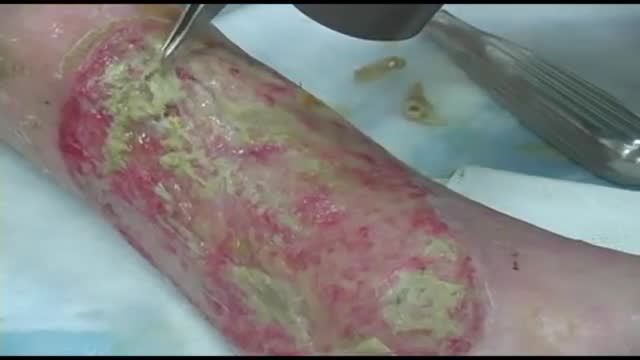
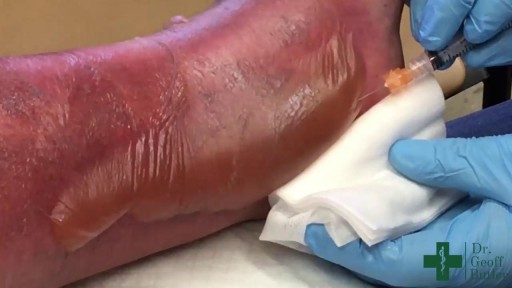
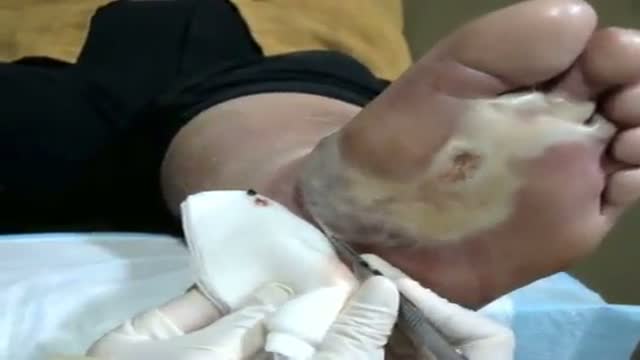
Wound-care specialist Dr. Randy Wolcott demonstrates sharp debridement of an eschar on a diabetic foot ulcer. Teasing away layer after layer with scissors, he explains how the endpoint is judged by feel, sight and sound until healthy host tissue is reached. He also discusses why undermining and tunneling are opened up as a foundation of wound care.
Key points
- The clinician teases away eschar layers with scissors
- The endpoint is judged by sight, feel and the sound of the tissue
- Soft and friable tissue is removed until healthy tissue is reached
- Bleeding during debridement and ways it is managed are discussed
- Undermining and tunneling are opened up during the procedure
Chapters
- 0:01 — Eschar on a diabetic foot ulcer
- 0:29 — Judging tissue by sight, sound, feel
- 1:38 — Host tissue and healing discussion
- 3:05 — Managing bleeding during debridement
- 4:07 — Removing friable tissue, opening tunneling
Video Transcript
Wound-care specialist Dr. Randy Wolcott demonstrates and explains sharp debridement of an eschar on a diabetic foot ulcer. Teasing away layer after layer with scissors, he describes how the endpoint is judged by feel, sight and even sound — soft, friable and fibrous tissue comes out until healthy host tissue is reached — and why undermining and tunneling are opened up as the foundation of wound care.
Read the full transcript
This is Dr. Randy Wolcott and what we want to talk about on this wound is Removing tissue and layers. So this is an escar. This is also a diabetic foot ulcer And what we're going to do is just simply tease away layer after layer until we get down into good host tissue You can do this With a blade with scissors just any sharp method that works for you in this Demonstration what we'll be using is scissors the question always comes up is how much do you remove and this is going to be based on feel?
Touching it with your instruments touching it with your finger and getting a feel for what's normal tissue It's going to be based on sight is it
Do we see bleeding? Do we see that the colors of normal tissue when we're going down to the different layers?
Also, there's we'll hear the different tissues as we Use our scissors or a cure at or whatever you can hear more fibrotic You can feel more fibrotic tissue with your scissors. So we're hearing we're seeing We're feeling Through multiple different modalities and we're just trying to get into good tissue Dr. Flange once told me during a conference that it's hard for him to imagine taking off too much tissue Because if we get into good host tissue it always regenerates itself. He said that in the context of
We just talked about bobsies and one of the thing about Bob seeing chronic wounds is that the Bobsy into the good tissue will heal up to the level of the chronic wound quite quickly and And then stop at that level. So if we do get into too much good host tissue It's going to heal right back to the wound before it stops healing what we're doing now is we're just kind of taking a time out I'm getting the the Hyperkeratosis around the wound that's caused by the wound inflammation and and just letting things bleed
Just you know get in a field for you know, what's
Producing blood and what's not if you just keep going It takes a while before all the bleeding declares itself. So we're just this is a timeout To let things bleed What we're going to do after we get this off is we're going to go back in field the wound with our scissors field the wound with the finger Use whatever Senses are appropriate and and just try to get back into good tissue and with the topicals and the systemic antibiotics the Specific selective bobsies we feel like we don't have to go into host tissue near as deeply
As we used to and that limits some of the bleeding But if you do get into bleeding there's products such as quick clot products such as silver nitrate now both of those can cause some wholesale damage, but You occasionally you have to stop the bleeding with those kind of products The other thing is you sometimes have to over so with a suture if you get into an arterial Bleeder or sometimes in venous leg ulcers if you get into the vein But with the newer topical products We don't go near as deep as we used to try to get all the black off the wound
For no other reason than the next time you see that wound you know what's died back and what hasn't died back if you leave a lot of black Tissue on the rim or in the base of the wound then there's you don't know what's died back in between Even with the pitchers it makes it too difficult to get all the necrotic tissue off Go down into host tissue Anything that's soft and friable has to come out anything that's hard and fibrous should come out We open up all undermining we open up all tunneling so you can see that the bereavement is the foundation of our wound care
Transcript auto-generated from the video’s audio for accessibility and study. Educational content only — not medical advice.
Video Overview
Other: part of the MedicalVideos.com library of free educational medical and surgery videos. Browse this category →
Medical Videos
Free medical and surgery videos for patients, students and professionals — trusted since 2007.
Founded by Dr. Mohamed Ibrahim, MD, PhD — physician-scientist.
Follow us on Facebook · Instagram
SORT BY-
Top Comments
-
Latest comments