
- Physical Examination
- Surgical Examination
- Ophthalmology
- Clinical Skills
- Orthopedics
- Surgery Videos
- Laparoscopy
- Pediatrics
- Funny Videos
- Cardiothoracic Surgery
- Nursing Videos
- Plastic Surgery
- Otorhinolaryngology
- Histology and Histopathology
- Neurosurgery
- Dermatology
- Pediatric Surgery
- Urology
- Dentistry
- Oncology and Cancers
- Anatomy Videos
- Health and Fitness
- Radiology
- Anaesthesia
- Physical Therapy
- Pharmacology
- Interventional Radiology
- Cardiology
- Endocrinology
- Gynecology
- Emergency Medicine
- Psychiatry and Psychology
- Childbirth Videos
- General Medical Videos
- Nephrology
- Physiology
- Diet and Food Health
- Diabetes Mellitus
- Neurology
- Women Health
- Osteoporosis
- Gastroenterology
- Pulmonology
- Hematology
- Rheumatology
- Toxicology
- Nuclear Medicine
- Infectious Diseases
- Vascular Disease
- Reproductive Health
- Burns and Wound Healing
- Kidney Zone Podcast
- Other
Chorionic villus sampling (CVS)
Category: Women's Health & Childbirth · All women's health & childbirth
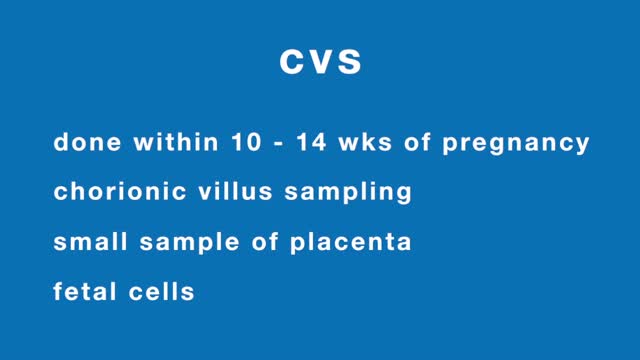
What it is
CVS takes a tiny sample of the developing placenta (chorionic villi) for genetic testing of the baby, usually between 11 and 14 weeks of pregnancy. The sample is taken through the abdomen with a needle (transabdominal) or through the cervix (transcervical), under ultrasound guidance.
Why it is done
It diagnoses chromosomal conditions (such as Down's, Edwards' and Patau's syndromes) and specific inherited conditions (for example cystic fibrosis, sickle cell disease, thalassaemia) earlier than amniocentesis allows.
How to prepare
You will have detailed counselling and an ultrasound to confirm dates and plan the route. Blood group is checked for anti-D. No fasting is needed. You will be told the unit's own miscarriage-risk figure as part of consent.
What happens during the procedure
For the transabdominal route, after local anaesthetic, a needle passes through the abdomen into the placenta and a small sample is drawn with suction under ultrasound vision. It takes about 10 minutes; cramping and pressure are typical. The transcervical route uses a fine tube through the cervix.
Afterwards — recovery & results
Take it easy for the rest of the day; mild cramps and spotting can occur. Report heavy pain, bleeding, fluid loss or fever. Rapid results for the major chromosomal conditions come in a few days; full results take about two weeks. Occasionally the result reflects the placenta rather than the baby (confined placental mosaicism) and amniocentesis is offered to clarify.
Risks & considerations
The procedure-related miscarriage risk is small and comparable to amniocentesis in experienced hands (your unit will quote its audited figure). Other risks include infection, bleeding and — with the transcervical route or very early CVS (before 10 weeks, now avoided) — specific fetal concerns, which is why timing is standardised.
Watch: Chorionic villus sampling (CVS) videos
Real procedure videos from the MedicalVideos.com library. Some clinical footage is graphic — that is the nature of a medical video library.
Related guides on MedicalVideos.com
Frequently asked questions
Why might I still need amniocentesis after CVS?
In about 1 in 100 cases the placental result is mosaic (mixed) and may not represent the baby. Amniocentesis tests the baby's own cells to resolve it.
Does CVS test for everything?
No — it tests chromosomes and the specific genetic conditions arranged. Neural tube defects such as spina bifida are screened separately by blood tests and the anomaly ultrasound scan.
Related procedures — Women's Health & Childbirth
Browse the C section of the A–Z list or return to the Procedures & Tests hub.