
- Physical Examination
- Surgical Examination
- Ophthalmology
- Clinical Skills
- Orthopedics
- Surgery Videos
- Laparoscopy
- Pediatrics
- Funny Videos
- Cardiothoracic Surgery
- Nursing Videos
- Plastic Surgery
- Otorhinolaryngology
- Histology and Histopathology
- Neurosurgery
- Dermatology
- Pediatric Surgery
- Urology
- Dentistry
- Oncology and Cancers
- Anatomy Videos
- Health and Fitness
- Radiology
- Anaesthesia
- Physical Therapy
- Pharmacology
- Interventional Radiology
- Cardiology
- Endocrinology
- Gynecology
- Emergency Medicine
- Psychiatry and Psychology
- Childbirth Videos
- General Medical Videos
- Nephrology
- Physiology
- Diet and Food Health
- Diabetes Mellitus
- Neurology
- Women Health
- Osteoporosis
- Gastroenterology
- Pulmonology
- Hematology
- Rheumatology
- Toxicology
- Nuclear Medicine
- Infectious Diseases
- Vascular Disease
- Reproductive Health
- Burns and Wound Healing
- Kidney Zone Podcast
- Other
Spinal fusion: What to Expect & Recovery
Spinal fusion joins two or more vertebrae so they heal as one bone, stabilising an unstable or deforming segment. It is the biggest operation in this section: several days in hospital, desk work at 6 to 8 weeks, heavy work at 3 to 6 months, and bone fusion maturing over a year.
Before surgery: how to prepare
- Ask exactly which levels will be fused, from which approach (back, front or side — sometimes combined), and whether decompression is included; recovery differs by approach.
- Stop smoking and nicotine completely if you possibly can: nicotine markedly increases the risk the fusion does not knit (non-union), the operation's distinctive failure mode.
- Prepare the home thoroughly: no bending, lifting or twisting (BLT restrictions) govern early recovery — rehearse log-rolling and hip-hinge movements before admission, with physiotherapy if offered.
- Iron, vitamin D and bone health matter for fusion: your team may check and optimise them, and review medicines that affect bone healing (including long-term steroids and some anti-inflammatories).
The day of surgery
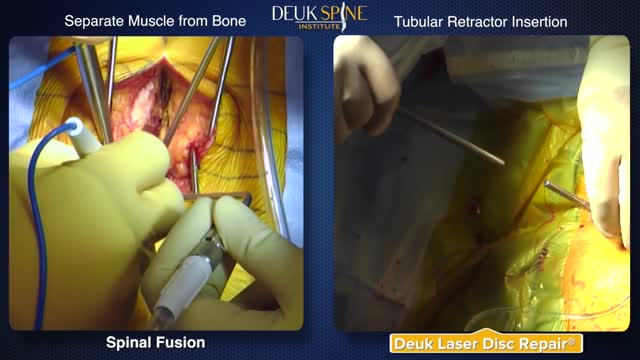
Under a general anaesthetic, the surgeon decompresses nerves as needed, removes the disc between the vertebrae being joined, inserts a cage packed with bone graft, and fixes the segment with screws and rods. Surgery takes several hours. You wake with a drain, a catheter, and strong pain relief (often a patient-controlled pump), and sit up and stand with physiotherapy the next day.
In hospital
Recovery timeline
Every recovery is individual, but most follow this general arc:
Warning signs: when to get help
- Bladder or bowel change, or saddle numbness — emergency
- New or worsening leg weakness
- Clear fluid leaking from the wound, or severe headache on standing (spinal fluid leak)
- Fever, wound redness or discharge
- Calf swelling or pain, chest pain or breathlessness
Related topics
Watch: real operation videos
From the MedicalVideos library. Some surgical videos are graphic and intended for education.
Frequently asked questions
How will I know the fusion has worked?
Two ways: your symptoms (stability pain and nerve pain improving) and imaging — X-rays and sometimes CT show bone bridging the segment over 6 to 12 months. Hardware holds things still while biology does the joining; that is why nicotine avoidance and load discipline matter for a full year, not just the first weeks.
Will I be stiff forever?
The fused levels no longer move — that is the point — but most everyday flexibility comes from the hips and the remaining spinal levels, and physiotherapy maximises both. A single-level fusion is barely noticeable in daily life once healed; multi-level fusions are felt more, a trade-off accepted for stability and pain relief.
Medically reviewed by Dr. Mohamed Ibrahim, Assistant Professor of Medicine, Transplant Nephrology, University of Maryland School of Medicine. Last reviewed: 12 November 2026.