
- Physical Examination
- Surgical Examination
- Ophthalmology
- Clinical Skills
- Orthopedics
- Surgery Videos
- Laparoscopy
- Pediatrics
- Funny Videos
- Cardiothoracic Surgery
- Nursing Videos
- Plastic Surgery
- Otorhinolaryngology
- Histology and Histopathology
- Neurosurgery
- Dermatology
- Pediatric Surgery
- Urology
- Dentistry
- Oncology and Cancers
- Anatomy Videos
- Health and Fitness
- Radiology
- Anaesthesia
- Physical Therapy
- Pharmacology
- Interventional Radiology
- Cardiology
- Endocrinology
- Gynecology
- Emergency Medicine
- Psychiatry and Psychology
- Childbirth Videos
- General Medical Videos
- Nephrology
- Physiology
- Diet and Food Health
- Diabetes Mellitus
- Neurology
- Women Health
- Osteoporosis
- Gastroenterology
- Pulmonology
- Hematology
- Rheumatology
- Toxicology
- Nuclear Medicine
- Infectious Diseases
- Vascular Disease
- Reproductive Health
- Burns and Wound Healing
- Kidney Zone Podcast
- Other
Polycystic Kidney Disease
Polycystic kidney disease is an inherited condition in which clusters of fluid-filled sacs, called cysts, grow in the kidneys and slowly enlarge them. This page explains its symptoms, causes, and treatment in plain language, with videos to help you follow the key points.
✓ Medically reviewed by Dr. Mohamed Ibrahim, MD, PhD — physician-scientist · Last reviewed: November 2026
In short: In polycystic kidney disease, inherited gene changes cause cysts to grow in the kidneys over many years. The kidneys gradually enlarge and may lose function, while blood pressure rises. There is no cure yet, but careful blood pressure control and monitoring slow the damage.
Watch: Polycystic Kidney Disease videos

Read: the plain-language guide
Overview
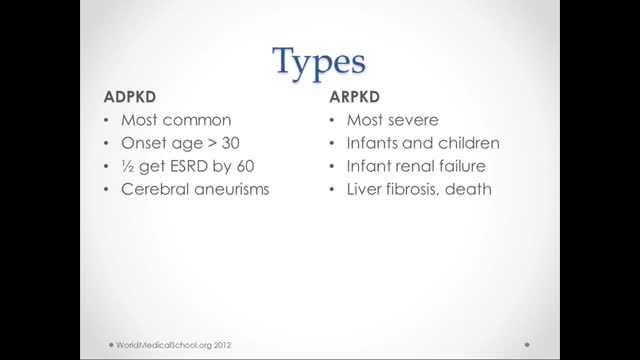
Healthy kidneys filter waste and excess fluid from the blood. In polycystic kidney disease, many fluid-filled cysts develop inside both kidneys, growing in number and size over decades. The enlarged kidneys gradually lose filtering ability, and cysts can also appear in the liver. The common form, autosomal dominant polycystic kidney disease, usually causes no problems until adulthood, and kidney function may remain good for many years. A much rarer form affects babies and children. Because it runs in families, one person's diagnosis often prompts relatives to be checked.
Symptoms
Many people have no symptoms for years, and the condition may be found only on a scan done for another reason or through family screening. When symptoms appear they can include aching pain in the back or side, blood in the urine, repeated urine infections, and kidney stones. High blood pressure is common and may be the first sign. As kidney function declines over time, tiredness, swelling, and other symptoms of kidney failure can develop. A family history of the condition or of kidney failure is an important clue.
Causes & risk factors
Polycystic kidney disease is caused by changes in genes that control how kidney tubules grow. In the common autosomal dominant form, the condition passes from parent to child, so a child of an affected parent can inherit the gene change. The rarer recessive form appears in childhood and requires a gene change from both parents. The gene change is present from birth, but cysts grow slowly, which is why symptoms usually appear in mid-adult life.
How it's diagnosed
Diagnosis is usually made with an ultrasound scan showing multiple cysts in both kidneys, interpreted alongside age and family history. CT or MRI scans give more detail and can measure total kidney size, which helps predict how fast it may progress. Blood and urine tests check kidney function, and blood pressure is measured regularly. Genetic testing is sometimes offered, for example when family history is unclear or a relative is considering donating a kidney. Adult relatives are often offered screening scans and blood pressure checks.
Treatment overview
There is no cure, so treatment focuses on protecting the kidneys and managing complications. Controlling blood pressure carefully is the single most important step, and your doctor may prescribe blood pressure medicines known to protect the kidneys. Infections are treated promptly, stones are managed as they arise, and pain is controlled with measures that avoid straining the kidneys. For some adults whose disease is progressing quickly, a specialist may offer a medicine that slows cyst growth. If the kidneys eventually fail, dialysis or a kidney transplant can take over their work.
When to seek care
Seek urgent care for visible blood in the urine, severe pain in the side, or fever with urine symptoms, which may mean an infected cyst. A sudden, worst-ever headache needs emergency assessment, because this condition is linked to weakened blood vessels in the brain.
Frequently asked questions
Is polycystic kidney disease inherited?
Yes. The common form passes from parent to child, so each child of an affected parent can inherit it, although severity varies widely even within one family. If you are diagnosed, your doctor will usually suggest that adult relatives are offered screening and blood pressure checks.
Will I definitely need dialysis one day?
No. Many people with polycystic kidney disease keep good kidney function for decades, and some never need dialysis. Regular monitoring of kidney function and blood pressure, plus prompt treatment of infections, gives the best chance of slowing the decline.
Are the kidney cysts cancerous?
No. The cysts in polycystic kidney disease are benign, fluid-filled sacs and do not turn into cancer. They cause problems by enlarging the kidneys and squeezing healthy tissue, and sometimes by bleeding or becoming infected.
Should my children be tested?
Children are not usually scanned routinely, because cysts may not appear until adulthood and there is no treatment to start in childhood. Blood pressure checks are sensible as they grow up. Adult children can discuss screening scans or genetic testing with their doctor when they are ready.
More in Kidneys & Urinary
Related topics on MedicalVideos.com
Sources & further reading
Authoritative references for readers who want to go deeper:
This page is for general education only and is not medical advice. A sudden, severe headache is an emergency for anyone with polycystic kidney disease, because the condition is linked to a higher chance of a weakened blood vessel in the brain.