- Physical Examination
- Surgical Examination
- Ophthalmology
- Clinical Skills
- Orthopedics
- Surgery Videos
- Laparoscopy
- Pediatrics
- Funny Videos
- Cardiothoracic Surgery
- Nursing Videos
- Plastic Surgery
- Otorhinolaryngology
- Histology and Histopathology
- Neurosurgery
- Dermatology
- Pediatric Surgery
- Urology
- Dentistry
- Oncology and Cancers
- Anatomy Videos
- Health and Fitness
- Radiology
- Anaesthesia
- Physical Therapy
- Pharmacology
- Interventional Radiology
- Cardiology
- Endocrinology
- Gynecology
- Emergency Medicine
- Psychiatry and Psychology
- Childbirth Videos
- General Medical Videos
- Nephrology
- Physiology
- Diet and Food Health
- Diabetes Mellitus
- Neurology
- Women Health
- Osteoporosis
- Gastroenterology
- Pulmonology
- Hematology
- Rheumatology
- Toxicology
- Nuclear Medicine
- Infectious Diseases
- Vascular Disease
- Reproductive Health
- Burns and Wound Healing
- Kidney Zone Podcast
- Other
CPR for Babies (Under 1 Year)
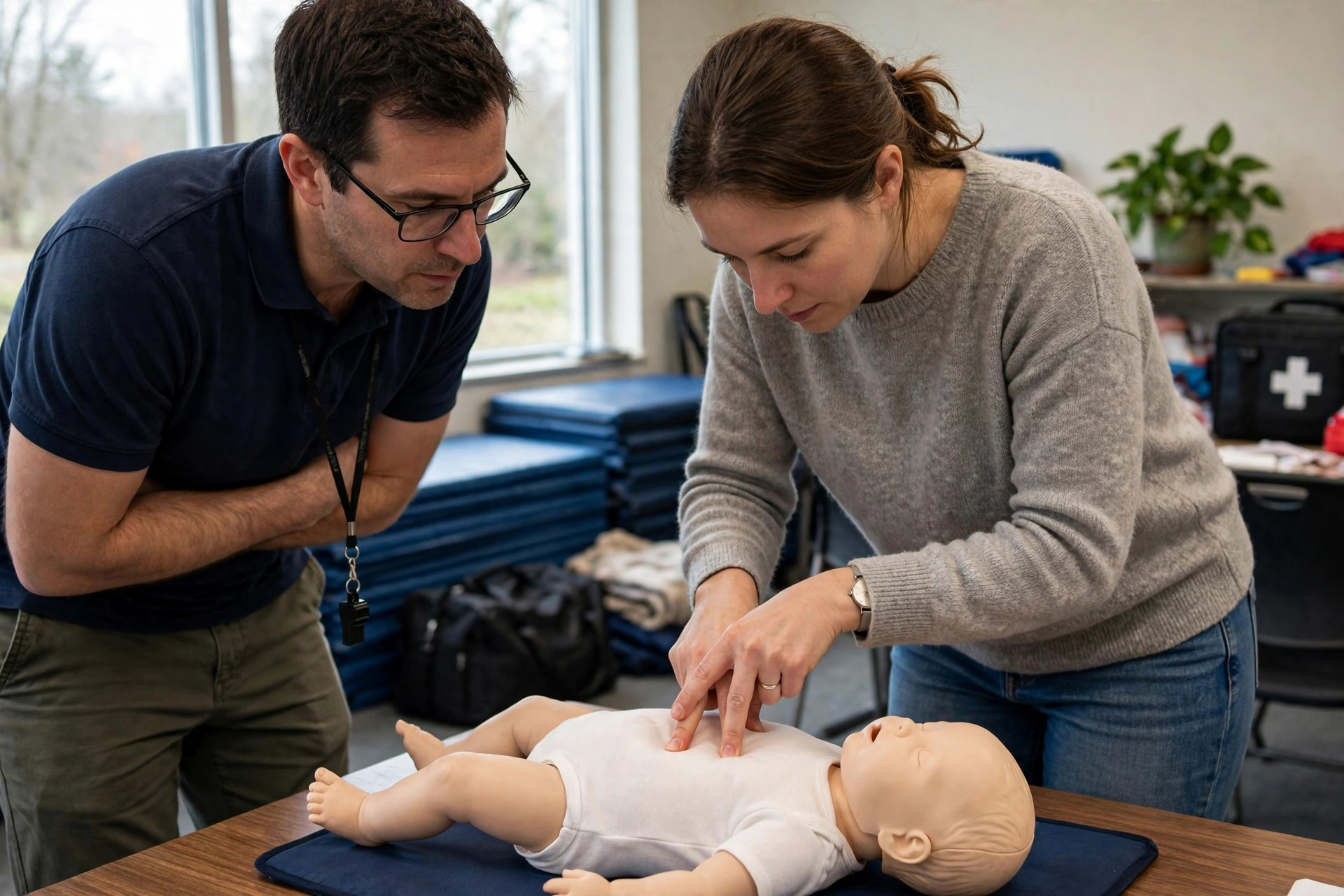
What to do
- Check the scene is safe, then check for a response: tap the baby's foot and call their name.
- If there is no response, shout for help and call 911 (or your local emergency number) on speakerphone, or ask a bystander to call.
- Open the airway: tilt the head very slightly back (neutral position) and lift the chin with one fingertip. Check for normal breathing for no more than 10 seconds.
- If the baby is not breathing normally and you are trained, give 5 initial rescue breaths: cover the baby's mouth and nose with your mouth and blow gently for about a second, watching the chest rise.
- Start chest compressions: place two fingers in the centre of the chest, just below the nipple line, and press down by about one third of the chest depth (about 1.5 inches / 4 cm), at 100 to 120 per minute.
- If trained, continue 30 compressions to 2 breaths. If untrained, do continuous compressions. A trained rescuer may use the two-thumb technique if the baby is large enough.
- Continue until help arrives and takes over, the baby starts breathing normally, or you cannot go on.
What NOT to do
- Do not shake the baby to check for a response.
- Do not tilt a baby's head far back — a slight tilt to a neutral position opens the airway; too far can close it.
- Do not blow hard — gentle puffs are enough to make a baby's chest rise.
- Do not press on the stomach or the lowest tip of the breastbone.
When to get medical care
Call 911 immediately for any unresponsive baby who is not breathing normally. All babies who have needed CPR must be assessed urgently in hospital, even if they seem completely recovered.
Related symptoms
Watch: related videos
Frequently asked questions
How do I do chest compressions on a baby?
Use two fingers in the centre of the chest just below the nipple line. Press down about one third of the chest depth — roughly 1.5 inches (4 cm) — at 100 to 120 compressions a minute, letting the chest come back up each time.
Why do babies get rescue breaths first?
Babies and children usually stop breathing before the heart stops, so oxygen in the breaths matters greatly. Trained rescuers give 5 initial rescue breaths before starting compressions, then cycles of 30 compressions to 2 breaths.
In an emergency, call 911 (or your local emergency number) first — do not delay a call to read a guide. These pages are educational first-aid information in general terms; they are not a substitute for emergency services, first-aid training, or assessment by a qualified clinician.