- Physical Examination
- Surgical Examination
- Ophthalmology
- Clinical Skills
- Orthopedics
- Surgery Videos
- Laparoscopy
- Pediatrics
- Funny Videos
- Cardiothoracic Surgery
- Nursing Videos
- Plastic Surgery
- Otorhinolaryngology
- Histology and Histopathology
- Neurosurgery
- Dermatology
- Pediatric Surgery
- Urology
- Dentistry
- Oncology and Cancers
- Anatomy Videos
- Health and Fitness
- Radiology
- Anaesthesia
- Physical Therapy
- Pharmacology
- Interventional Radiology
- Cardiology
- Endocrinology
- Gynecology
- Emergency Medicine
- Psychiatry and Psychology
- Childbirth Videos
- General Medical Videos
- Nephrology
- Physiology
- Diet and Food Health
- Diabetes Mellitus
- Neurology
- Women Health
- Osteoporosis
- Gastroenterology
- Pulmonology
- Hematology
- Rheumatology
- Toxicology
- Nuclear Medicine
- Infectious Diseases
- Vascular Disease
- Reproductive Health
- Burns and Wound Healing
- Kidney Zone Podcast
- Other
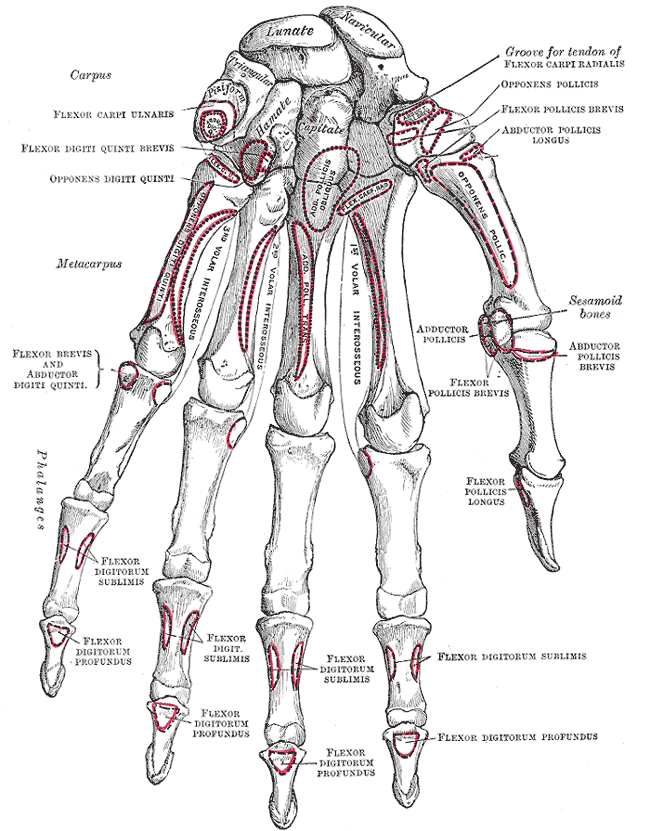
Capitate
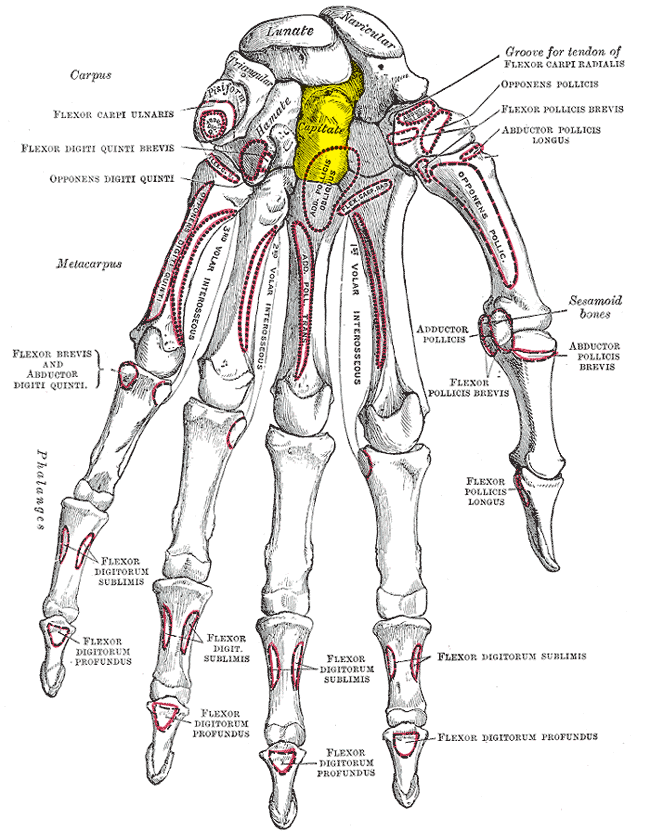
Gray's Anatomy (1918) plate, public domain
The capitate is the largest carpal bone, sitting at the centre of the wrist with its rounded head fitting into the cup formed by the scaphoid and lunate. The middle finger's metacarpal sits on it, so the capitate lies on the central axis of the hand — the line of load from the middle finger into the forearm.
Key facts
- The capitate is the largest of the eight carpals.
- It occupies the centre of the wrist, in the hand's longitudinal axis.
- Its head rotates within the scaphoid-lunate cup during wrist movement.
- The third metacarpal (middle finger) is anchored to it.
- It forms the stable central column of the wrist.
What can go wrong
The capitate is rarely injured alone; its neck can fracture together with the scaphoid in severe falls (scaphocapitate syndrome). Because it sits at the crossroads of wrist movement, arthritis developing around it after old injuries can stiffen the whole wrist.
Related procedures & tests
Related symptoms
Related muscles
Frequently asked questions
Why does capitate mean 'head-shaped'?
Its rounded proximal end — the head — is the largest single articular surface in the wrist, fitting into the cupped scaphoid and lunate like a ball into a socket.
Which finger lines up with the capitate?
The middle finger. A line drawn along the middle finger and its metacarpal passes straight through the capitate and up the forearm — the central axis around which the hand is organised.
Educational information only. This atlas explains normal anatomy and describes conditions in general terms; it is not medical advice and does not replace assessment by a qualified clinician. If you have symptoms that worry you, seek medical care.