- Physical Examination
- Surgical Examination
- Ophthalmology
- Clinical Skills
- Orthopedics
- Surgery Videos
- Laparoscopy
- Pediatrics
- Funny Videos
- Cardiothoracic Surgery
- Nursing Videos
- Plastic Surgery
- Otorhinolaryngology
- Histology and Histopathology
- Neurosurgery
- Dermatology
- Pediatric Surgery
- Urology
- Dentistry
- Oncology and Cancers
- Anatomy Videos
- Health and Fitness
- Radiology
- Anaesthesia
- Physical Therapy
- Pharmacology
- Interventional Radiology
- Cardiology
- Endocrinology
- Gynecology
- Emergency Medicine
- Psychiatry and Psychology
- Childbirth Videos
- General Medical Videos
- Nephrology
- Physiology
- Diet and Food Health
- Diabetes Mellitus
- Neurology
- Women Health
- Osteoporosis
- Gastroenterology
- Pulmonology
- Hematology
- Rheumatology
- Toxicology
- Nuclear Medicine
- Infectious Diseases
- Vascular Disease
- Reproductive Health
- Burns and Wound Healing
- Kidney Zone Podcast
- Other
Cerebellum
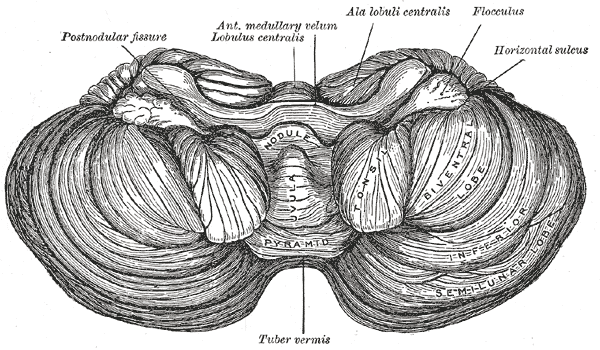
Gray's Anatomy (1918) plate, public domain
The cerebellum — 'little brain' — sits at the back of the skull, beneath the cerebrum. With more neurons than the rest of the brain combined, its finely folded surface fine-tunes movement: comparing intended actions with actual ones and correcting them, so movements are smooth and coordinated. It is also central to balance and to learning motor skills such as playing an instrument.
Key facts
- The cerebellum contains more neurons than the cerebrum.
- It receives copies of movement commands and of sensory feedback.
- Its middle part (vermis) coordinates trunk and balance; its hemispheres coordinate limbs.
- It does not initiate movement — it refines it.
- It also contributes to some cognitive and language timing functions.
What can go wrong
Cerebellar damage — from stroke, alcohol-related degeneration, tumours or inherited conditions — causes ataxia: unsteady gait, clumsy hand movements, slurred speech and flickering eye movements (nystagmus). In children, the cerebellum is a relatively common site of brain tumours, which are assessed urgently when headaches come with unsteadiness.
Related conditions
Related symptoms
Watch: related videos
Frequently asked questions
Why does alcohol affect balance so quickly?
The cerebellum is especially sensitive to alcohol, so its fine corrections of posture and eye movement falter early — producing the unsteady gait and slurred speech of intoxication, which is why coordination tests detect it.
Can you live without a cerebellum?
Rarely, people are born with almost no cerebellum and can still walk and talk, though with clumsiness and learning difficulties — the rest of the brain partially compensates, especially when the adaptation happens from birth.
Educational information only. This atlas explains normal anatomy and describes conditions in general terms; it is not medical advice and does not replace assessment by a qualified clinician. If you have symptoms that worry you, seek medical care.