- Physical Examination
- Surgical Examination
- Ophthalmology
- Clinical Skills
- Orthopedics
- Surgery Videos
- Laparoscopy
- Pediatrics
- Funny Videos
- Cardiothoracic Surgery
- Nursing Videos
- Plastic Surgery
- Otorhinolaryngology
- Histology and Histopathology
- Neurosurgery
- Dermatology
- Pediatric Surgery
- Urology
- Dentistry
- Oncology and Cancers
- Anatomy Videos
- Health and Fitness
- Radiology
- Anaesthesia
- Physical Therapy
- Pharmacology
- Interventional Radiology
- Cardiology
- Endocrinology
- Gynecology
- Emergency Medicine
- Psychiatry and Psychology
- Childbirth Videos
- General Medical Videos
- Nephrology
- Physiology
- Diet and Food Health
- Diabetes Mellitus
- Neurology
- Women Health
- Osteoporosis
- Gastroenterology
- Pulmonology
- Hematology
- Rheumatology
- Toxicology
- Nuclear Medicine
- Infectious Diseases
- Vascular Disease
- Reproductive Health
- Burns and Wound Healing
- Kidney Zone Podcast
- Other
Facial Nerve
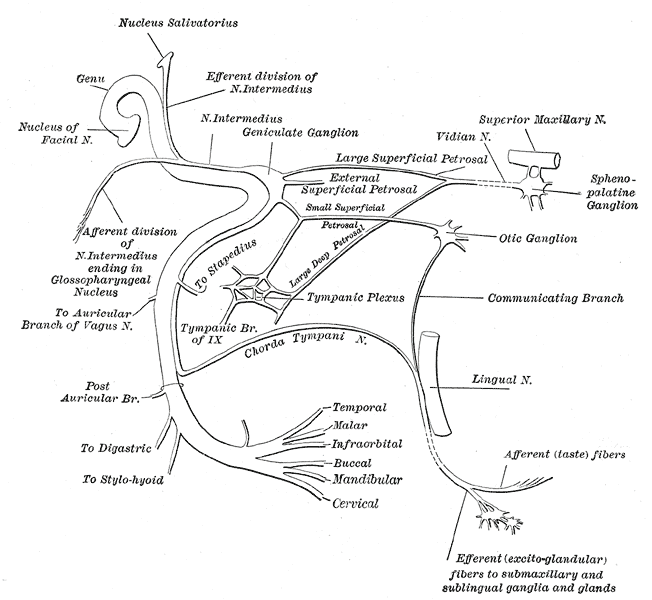
Gray's Anatomy (1918) plate, public domain
The facial nerve (cranial nerve VII) is the nerve of facial expression. Leaving the brainstem, it passes through the temporal bone beside the ear, gives a branch to the stapedius muscle and to taste buds of the front of the tongue, then emerges below the ear and fans out across the face in five branches to the muscles of expression. It also drives tear and salivary glands.
Key facts
- Its five terminal branches are remembered as: temporal, zygomatic, buccal, marginal mandibular and cervical.
- It carries taste from the front two-thirds of the tongue.
- It supplies the stapedius — the smallest muscle in the body.
- It drives the glands for tears and much of the mouth's saliva.
- It travels a long bony canal in the temporal bone, where swelling can squeeze it.
What can go wrong
Bell's palsy — sudden one-sided facial weakness, usually attributed to inflammation squeezing the nerve in its bony canal — is the best-known facial nerve disorder. The nerve can also be affected by shingles in the ear (Ramsay Hunt syndrome), parotid gland tumours and surgery, and skull-base fractures. Forehead involvement helps distinguish Bell's palsy from a stroke.
Related conditions
Related symptoms
Related muscles
Watch: related videos
Frequently asked questions
How do doctors tell Bell's palsy from a stroke?
In Bell's palsy the whole side of the face is weak, including the forehead, because the nerve itself is affected. In a stroke the forehead is usually spared, because the forehead receives signals from both sides of the brain.
Why does Bell's palsy sometimes change taste and sound?
The nerve carries more than movement: branches to the tongue's taste buds and to the stapedius (which dampens loud sounds) leave it along its course, so both taste and sound sensitivity can be disturbed.
Educational information only. This atlas explains normal anatomy and describes conditions in general terms; it is not medical advice and does not replace assessment by a qualified clinician. If you have symptoms that worry you, seek medical care.