- Physical Examination
- Surgical Examination
- Ophthalmology
- Clinical Skills
- Orthopedics
- Surgery Videos
- Laparoscopy
- Pediatrics
- Funny Videos
- Cardiothoracic Surgery
- Nursing Videos
- Plastic Surgery
- Otorhinolaryngology
- Histology and Histopathology
- Neurosurgery
- Dermatology
- Pediatric Surgery
- Urology
- Dentistry
- Oncology and Cancers
- Anatomy Videos
- Health and Fitness
- Radiology
- Anaesthesia
- Physical Therapy
- Pharmacology
- Interventional Radiology
- Cardiology
- Endocrinology
- Gynecology
- Emergency Medicine
- Psychiatry and Psychology
- Childbirth Videos
- General Medical Videos
- Nephrology
- Physiology
- Diet and Food Health
- Diabetes Mellitus
- Neurology
- Women Health
- Osteoporosis
- Gastroenterology
- Pulmonology
- Hematology
- Rheumatology
- Toxicology
- Nuclear Medicine
- Infectious Diseases
- Vascular Disease
- Reproductive Health
- Burns and Wound Healing
- Kidney Zone Podcast
- Other
Parietal Bone
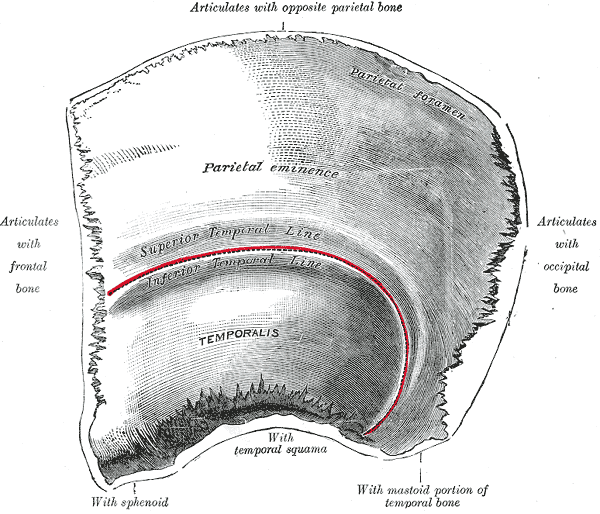
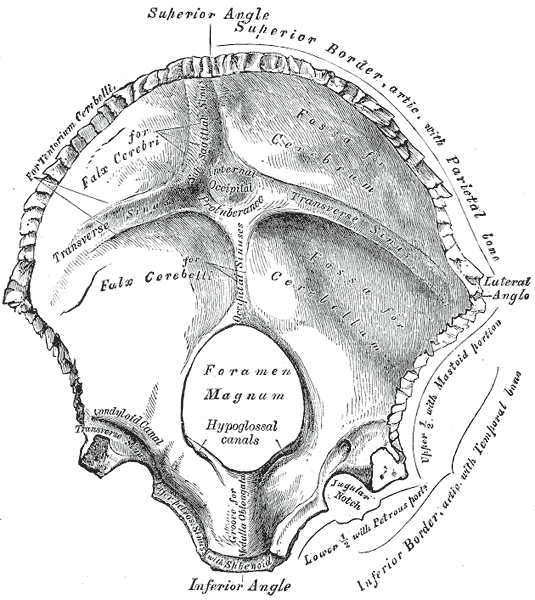
Gray's Anatomy (1918) plate, public domain
The two parietal bones form the roof and upper sides of the cranium. Each is a broad, curved, four-sided plate. They meet each other at the sagittal suture along the top of the head, the frontal bone at the coronal suture, and the occipital bone at the lambdoid suture.
Key facts
- There are two parietal bones, one on each side of the crown.
- Together they form most of the skull's roof and upper walls.
- They meet at the sagittal suture, the joint running front-to-back over the top of the head.
- Beneath the left parietal bone in most people lies brain important for language.
- The parietal eminence — the widest part of the skull — is where a baby's head is measured across.
What can go wrong
The parietal bones are a common site of skull fractures in falls and impacts. In babies, a parietal bone can be gently dented by birth instruments or pressure — a so-called ping-pong fracture that is usually monitored. Bleeding can collect between a parietal bone and its outer covering after a knock, forming a scalp swelling.
Related procedures & tests
Related symptoms
Frequently asked questions
Why are there two parietal bones?
The skull develops in paired halves that grow towards each other as the brain enlarges. The parietal bones are the left and right plates of the crown; they meet at the sagittal suture and fuse there later in life.
Can you feel the parietal bones?
Yes — the hard curved surfaces on the top and upper sides of your head, above and slightly behind your ears, are the parietal bones under the scalp.
Educational information only. This atlas explains normal anatomy and describes conditions in general terms; it is not medical advice and does not replace assessment by a qualified clinician. If you have symptoms that worry you, seek medical care.