- Physical Examination
- Surgical Examination
- Ophthalmology
- Clinical Skills
- Orthopedics
- Surgery Videos
- Laparoscopy
- Pediatrics
- Funny Videos
- Cardiothoracic Surgery
- Nursing Videos
- Plastic Surgery
- Otorhinolaryngology
- Histology and Histopathology
- Neurosurgery
- Dermatology
- Pediatric Surgery
- Urology
- Dentistry
- Oncology and Cancers
- Anatomy Videos
- Health and Fitness
- Radiology
- Anaesthesia
- Physical Therapy
- Pharmacology
- Interventional Radiology
- Cardiology
- Endocrinology
- Gynecology
- Emergency Medicine
- Psychiatry and Psychology
- Childbirth Videos
- General Medical Videos
- Nephrology
- Physiology
- Diet and Food Health
- Diabetes Mellitus
- Neurology
- Women Health
- Osteoporosis
- Gastroenterology
- Pulmonology
- Hematology
- Rheumatology
- Toxicology
- Nuclear Medicine
- Infectious Diseases
- Vascular Disease
- Reproductive Health
- Burns and Wound Healing
- Kidney Zone Podcast
- Other
Skull Sutures
Gray's Anatomy (1918) plate, public domain
Sutures are the wavy, fibrous joints between the bones of the cranium. The main ones are the coronal suture across the front, the sagittal suture along the top, the lambdoid suture at the back and the squamosal sutures around the temples. They allow the skull to grow in childhood and gradually fuse in adult life.
Key facts
- The four main sutures are coronal, sagittal, lambdoid and squamosal (paired).
- Their zigzag edges interlock, making the joint strong.
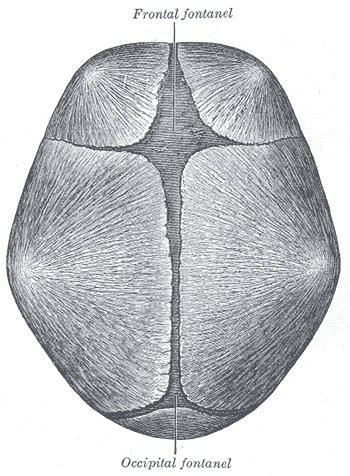
- In infancy they are soft and allow the skull to expand as the brain grows.
- They fuse progressively with age — the process is used (roughly) to estimate age in anthropology.
- The point where coronal and sagittal sutures meet is called the bregma.
What can go wrong
If a suture fuses too early in a baby (craniosynostosis), the skull grows in a distorted shape because it cannot expand across the closed joint; this is usually treated with surgery in infancy. In adults, sutures cause no symptoms — their importance is mainly as landmarks for imaging and surgery.
Related procedures & tests
Frequently asked questions
Do skull sutures ever fully disappear?
They narrow and bone over gradually from early adulthood onwards, but the process is slow and variable — many older adults still show clear suture lines on scans.
What is craniosynostosis?
Early fusion of one or more skull sutures in a baby. Because the skull cannot grow across a fused suture, it grows more in other directions, producing a characteristic head shape that specialists assess.
Educational information only. This atlas explains normal anatomy and describes conditions in general terms; it is not medical advice and does not replace assessment by a qualified clinician. If you have symptoms that worry you, seek medical care.