- Physical Examination
- Surgical Examination
- Ophthalmology
- Clinical Skills
- Orthopedics
- Surgery Videos
- Laparoscopy
- Pediatrics
- Funny Videos
- Cardiothoracic Surgery
- Nursing Videos
- Plastic Surgery
- Otorhinolaryngology
- Histology and Histopathology
- Neurosurgery
- Dermatology
- Pediatric Surgery
- Urology
- Dentistry
- Oncology and Cancers
- Anatomy Videos
- Health and Fitness
- Radiology
- Anaesthesia
- Physical Therapy
- Pharmacology
- Interventional Radiology
- Cardiology
- Endocrinology
- Gynecology
- Emergency Medicine
- Psychiatry and Psychology
- Childbirth Videos
- General Medical Videos
- Nephrology
- Physiology
- Diet and Food Health
- Diabetes Mellitus
- Neurology
- Women Health
- Osteoporosis
- Gastroenterology
- Pulmonology
- Hematology
- Rheumatology
- Toxicology
- Nuclear Medicine
- Infectious Diseases
- Vascular Disease
- Reproductive Health
- Burns and Wound Healing
- Kidney Zone Podcast
- Other
Thymus
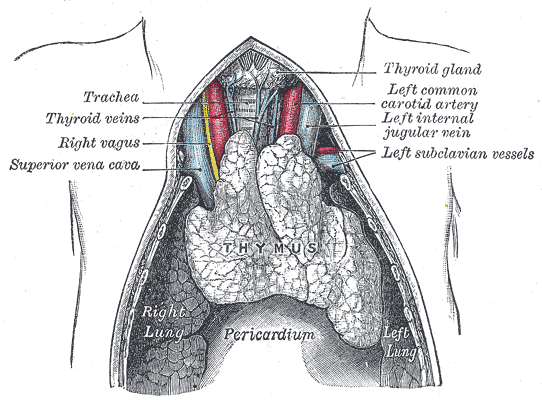
Gray's Anatomy (1918) plate, public domain
The thymus is a soft, two-lobed organ sitting behind the breastbone in the upper chest, where T lymphocytes (T cells) mature. Immature cells from the bone marrow enter the thymus and are educated there — those that react too strongly to the body's own tissues are deleted, while useful ones are licensed to leave. The gland is largest and most active in childhood and gradually shrinks and fattens after puberty (involution).
Key facts
- A newborn's thymus is large relative to the chest; it peaks around puberty at roughly 30-40 g.
- Over 95% of developing T cells fail the thymus's selection tests and die there — quality control is strict.
- The thymus is where the 'T' in T cell comes from.
- Even in adults, when the gland is mostly fatty, a small output of new T cells continues.
What can go wrong
The thymus is central to the autoimmune disease myasthenia gravis, in which it often harbours abnormal germinal centres; removing it helps some patients. Tumours of the gland (thymomas) are uncommon and often found incidentally or through associated myasthenia. Children born without a functioning thymus (as in DiGeorge syndrome) have profound T-cell deficiency and recurrent infections.
Related procedures & tests
Related symptoms
Frequently asked questions
Why does the thymus shrink with age?
Involution after puberty reflects the fact that the repertoire of T cells is largely built in childhood; the consequence is a slower immune response to new infections and vaccines in older age.
What is a thymoma?
A usually slow-growing tumour of the thymus's epithelial cells, often discovered by chance on imaging or through its association with myasthenia gravis.
Educational information only. This atlas explains normal anatomy and describes conditions in general terms; it is not medical advice and does not replace assessment by a qualified clinician. If you have symptoms that worry you, seek medical care.