- Physical Examination
- Surgical Examination
- Ophthalmology
- Clinical Skills
- Orthopedics
- Surgery Videos
- Laparoscopy
- Pediatrics
- Funny Videos
- Cardiothoracic Surgery
- Nursing Videos
- Plastic Surgery
- Otorhinolaryngology
- Histology and Histopathology
- Neurosurgery
- Dermatology
- Pediatric Surgery
- Urology
- Dentistry
- Oncology and Cancers
- Anatomy Videos
- Health and Fitness
- Radiology
- Anaesthesia
- Physical Therapy
- Pharmacology
- Interventional Radiology
- Cardiology
- Endocrinology
- Gynecology
- Emergency Medicine
- Psychiatry and Psychology
- Childbirth Videos
- General Medical Videos
- Nephrology
- Physiology
- Diet and Food Health
- Diabetes Mellitus
- Neurology
- Women Health
- Osteoporosis
- Gastroenterology
- Pulmonology
- Hematology
- Rheumatology
- Toxicology
- Nuclear Medicine
- Infectious Diseases
- Vascular Disease
- Reproductive Health
- Burns and Wound Healing
- Kidney Zone Podcast
- Other
Vomer
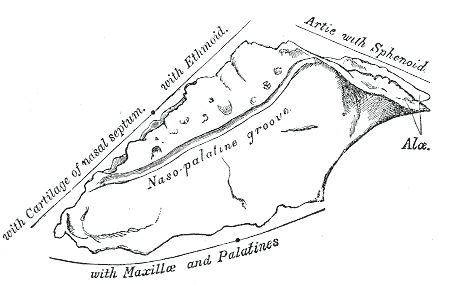
Gray's Anatomy (1918) plate, public domain
The vomer is a thin, flat, plough-shaped bone that forms the lower and back part of the nasal septum — the wall dividing the nose into left and right passages. Its upper edge meets the ethmoid bone, and its lower edge sits in a groove of the palate.
Key facts
- The vomer forms the lower half of the nasal septum.
- Its name comes from the Latin for a ploughshare, which it resembles.
- It meets the sphenoid above, the ethmoid in front and the palate below.
- Together with cartilage at the front, it keeps the two nasal passages separate.
- It is one of the unpaired bones of the face.
What can go wrong
The septum that the vomer helps form is very commonly slightly off-centre (a deviated septum); this is usually harmless but can contribute to a blocked feeling or nosebleeds if pronounced. The vomer can also be fractured along with other nasal bones in facial injuries, and septal blood collections after injury are checked for promptly.
Related symptoms
Watch: related videos
Frequently asked questions
What is the nasal septum made of?
Three parts: the vomer at the back and below, the perpendicular plate of the ethmoid above, and a plate of cartilage at the front. All three form the single wall between the nostrils.
Is a deviated septum abnormal?
It is extremely common and usually a normal variation rather than a disease. It only matters if it significantly blocks airflow or causes recurrent problems.
Educational information only. This atlas explains normal anatomy and describes conditions in general terms; it is not medical advice and does not replace assessment by a qualified clinician. If you have symptoms that worry you, seek medical care.