- Physical Examination
- Surgical Examination
- Ophthalmology
- Clinical Skills
- Orthopedics
- Surgery Videos
- Laparoscopy
- Pediatrics
- Funny Videos
- Cardiothoracic Surgery
- Nursing Videos
- Plastic Surgery
- Otorhinolaryngology
- Histology and Histopathology
- Neurosurgery
- Dermatology
- Pediatric Surgery
- Urology
- Dentistry
- Oncology and Cancers
- Anatomy Videos
- Health and Fitness
- Radiology
- Anaesthesia
- Physical Therapy
- Pharmacology
- Interventional Radiology
- Cardiology
- Endocrinology
- Gynecology
- Emergency Medicine
- Psychiatry and Psychology
- Childbirth Videos
- General Medical Videos
- Nephrology
- Physiology
- Diet and Food Health
- Diabetes Mellitus
- Neurology
- Women Health
- Osteoporosis
- Gastroenterology
- Pulmonology
- Hematology
- Rheumatology
- Toxicology
- Nuclear Medicine
- Infectious Diseases
- Vascular Disease
- Reproductive Health
- Burns and Wound Healing
- Kidney Zone Podcast
- Other
Atlas
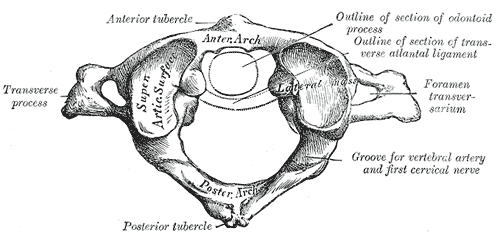
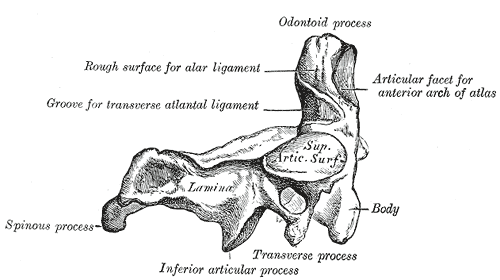
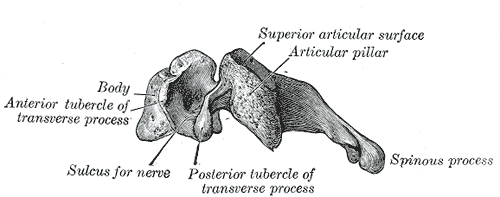
Gray's Anatomy (1918) plate, public domain
The atlas is the first cervical vertebra (C1), named after the Titan who held up the sky — because it holds up the head. It is unique: a ring of bone with no body and no spinous process. Its upper surfaces cup the knobs of the skull, forming the joint that nods the head.
Key facts
- The atlas has no vertebral body — it is a bony ring.
- It carries the weight of the entire head.
- Its joint with the skull produces the nodding ('yes') movement.
- The body it lacks became part of the axis below (the dens).
- The spinal cord passes through its centre, sharing space with the dens.
What can go wrong
The atlas can fracture in axial-loading injuries, such as diving into shallow water — the so-called Jefferson fracture. Because the cord passes through it, atlas injuries are assessed urgently, though its canal is relatively roomy. In rheumatoid arthritis, the ligament holding the dens can weaken, letting the atlas shift — a reason people with that condition report new neck symptoms promptly.
Related procedures & tests
Related symptoms
Related muscles
Frequently asked questions
Why does the atlas have no body?
During development its body fused to the vertebra below, becoming the peg (dens) of the axis. The atlas kept only its ring, which is exactly what it needs to cradle the skull.
Which movement happens at the atlas joint?
Nodding. The skull rocks forwards and backwards on the atlas; the side-to-side 'no' movement happens at the joint between atlas and axis below it.
Educational information only. This atlas explains normal anatomy and describes conditions in general terms; it is not medical advice and does not replace assessment by a qualified clinician. If you have symptoms that worry you, seek medical care.