- Physical Examination
- Surgical Examination
- Ophthalmology
- Clinical Skills
- Orthopedics
- Surgery Videos
- Laparoscopy
- Pediatrics
- Funny Videos
- Cardiothoracic Surgery
- Nursing Videos
- Plastic Surgery
- Otorhinolaryngology
- Histology and Histopathology
- Neurosurgery
- Dermatology
- Pediatric Surgery
- Urology
- Dentistry
- Oncology and Cancers
- Anatomy Videos
- Health and Fitness
- Radiology
- Anaesthesia
- Physical Therapy
- Pharmacology
- Interventional Radiology
- Cardiology
- Endocrinology
- Gynecology
- Emergency Medicine
- Psychiatry and Psychology
- Childbirth Videos
- General Medical Videos
- Nephrology
- Physiology
- Diet and Food Health
- Diabetes Mellitus
- Neurology
- Women Health
- Osteoporosis
- Gastroenterology
- Pulmonology
- Hematology
- Rheumatology
- Toxicology
- Nuclear Medicine
- Infectious Diseases
- Vascular Disease
- Reproductive Health
- Burns and Wound Healing
- Kidney Zone Podcast
- Other
Cauda Equina
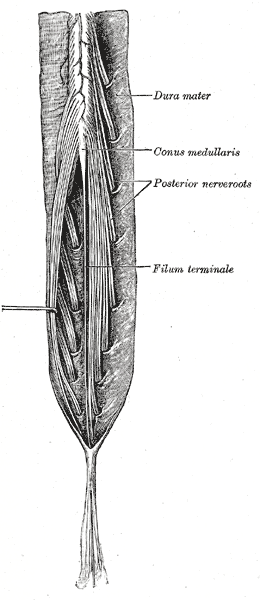
Gray's Anatomy (1918) plate, public domain
The cauda equina — Latin for 'horse's tail' — is the sheaf of lumbar and sacral nerve roots that descends within the spinal canal below the end of the spinal cord (around L1-L2) before exiting at successive levels. These roots supply the legs, the pelvic floor, bladder and bowel control and the saddle area (perineum). Floating in cerebrospinal fluid, they are mobile enough to be displaced safely by a lumbar puncture needle.
Key facts
- The name comes from its resemblance to a horse's tail streaming from the cord's tapered end (conus).
- It usually contains 18-20 individual nerve roots.
- The roots lack the protective sheathing of peripheral nerves, making them sensitive to compression and inflammation.
- Bladder and bowel fibres (S2-4) run in its core — hence their early involvement in compression syndromes.
What can go wrong
Cauda equina syndrome is compression of this bundle — usually by a large central disc prolapse — causing some combination of severe back pain, leg weakness or numbness, numbness in the saddle area, and loss of bladder or bowel control. It is a surgical emergency: delayed decompression risks permanent bladder, bowel and sexual dysfunction. Any back pain accompanied by these features needs same-day emergency assessment and MRI.
Related procedures & tests
Related symptoms
Frequently asked questions
What are the red flags of cauda equina syndrome?
New difficulty passing urine or incontinence, numbness around the buttocks and genitals (saddle area), weakness in both legs, and severe or progressive symptoms — these need emergency assessment.
Why is it an emergency?
The compressed roots are injured progressively; relieving pressure early gives the best chance of recovering bladder, bowel and leg function.
Educational information only. This atlas explains normal anatomy and describes conditions in general terms; it is not medical advice and does not replace assessment by a qualified clinician. If you have symptoms that worry you, seek medical care.