- Physical Examination
- Surgical Examination
- Ophthalmology
- Clinical Skills
- Orthopedics
- Surgery Videos
- Laparoscopy
- Pediatrics
- Funny Videos
- Cardiothoracic Surgery
- Nursing Videos
- Plastic Surgery
- Otorhinolaryngology
- Histology and Histopathology
- Neurosurgery
- Dermatology
- Pediatric Surgery
- Urology
- Dentistry
- Oncology and Cancers
- Anatomy Videos
- Health and Fitness
- Radiology
- Anaesthesia
- Physical Therapy
- Pharmacology
- Interventional Radiology
- Cardiology
- Endocrinology
- Gynecology
- Emergency Medicine
- Psychiatry and Psychology
- Childbirth Videos
- General Medical Videos
- Nephrology
- Physiology
- Diet and Food Health
- Diabetes Mellitus
- Neurology
- Women Health
- Osteoporosis
- Gastroenterology
- Pulmonology
- Hematology
- Rheumatology
- Toxicology
- Nuclear Medicine
- Infectious Diseases
- Vascular Disease
- Reproductive Health
- Burns and Wound Healing
- Kidney Zone Podcast
- Other
Facet Joints
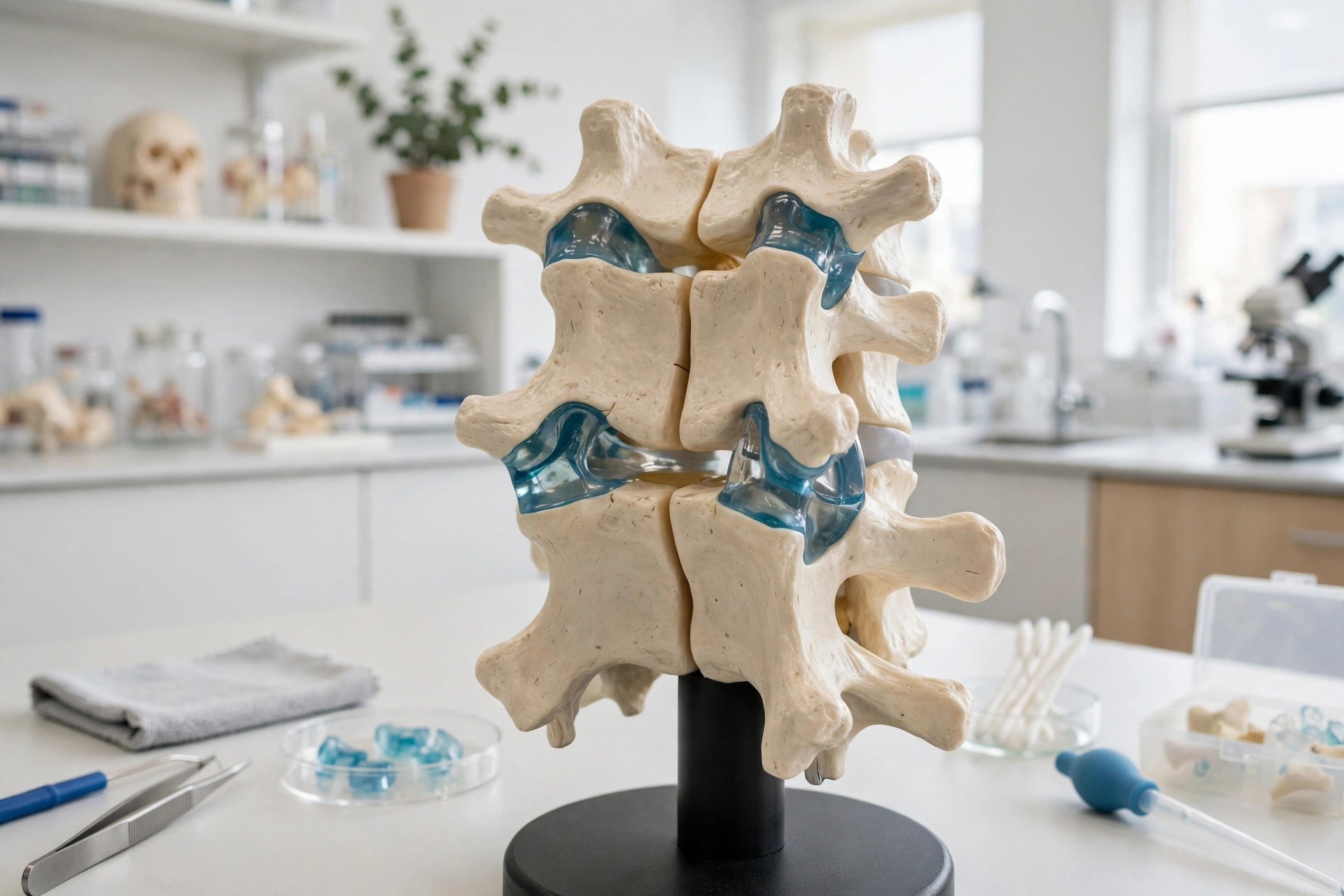
AI-generated anatomical illustration
The facet joints are the pairs of small synovial joints linking the back of each vertebra to the next — one pair per level. Together with the disc in front, they form a three-joint complex at each segment: the disc bears most weight while the facets guide and limit movement, preventing excessive rotation and forward slide. Their orientation varies by region — flatter in the neck for mobility, more interlocking in the lower back for stability.
Key facts
- Facet joints carry roughly a fifth of the spine's load in standing, more when the back extends.
- Each joint is supplied by two small nerves (medial branches) — the targets of diagnostic blocks and radiofrequency treatments.
- Their cartilage and capsule are rich in pain receptors, so arthritis here is genuinely painful.
- With age the joints develop osteoarthritis just as knees and hips do.
What can go wrong
Facet joint osteoarthritis is a common contributor to chronic back and neck pain, typically worse with extension (arching back) and prolonged standing, easing with flexion. Worn facets also allow abnormal slip of one vertebra on another (spondylolisthesis) and contribute to canal narrowing. Assessment is clinical and by imaging; injections into or around the joints can help confirm them as the pain source.
Related procedures & tests
- Radiofrequency denervation (RFA) for facet joint pain
- Nerve blocks for chronic pain (including facet joint and epidural)
- MRI scan — spine
Related symptoms
Frequently asked questions
How do facet joints cause back pain?
Their cartilage thins and the joint inflames with osteoarthritis; because the capsule is richly supplied with pain fibres, loading the joint — especially arching backwards — provokes localised pain and stiffness.
What is a medial branch block?
An injection of local anaesthetic around the tiny nerves supplying a facet joint; if pain briefly disappears, the joint is confirmed as a pain source and longer-acting treatments may be considered.
Educational information only. This atlas explains normal anatomy and describes conditions in general terms; it is not medical advice and does not replace assessment by a qualified clinician. If you have symptoms that worry you, seek medical care.