- Physical Examination
- Surgical Examination
- Ophthalmology
- Clinical Skills
- Orthopedics
- Surgery Videos
- Laparoscopy
- Pediatrics
- Funny Videos
- Cardiothoracic Surgery
- Nursing Videos
- Plastic Surgery
- Otorhinolaryngology
- Histology and Histopathology
- Neurosurgery
- Dermatology
- Pediatric Surgery
- Urology
- Dentistry
- Oncology and Cancers
- Anatomy Videos
- Health and Fitness
- Radiology
- Anaesthesia
- Physical Therapy
- Pharmacology
- Interventional Radiology
- Cardiology
- Endocrinology
- Gynecology
- Emergency Medicine
- Psychiatry and Psychology
- Childbirth Videos
- General Medical Videos
- Nephrology
- Physiology
- Diet and Food Health
- Diabetes Mellitus
- Neurology
- Women Health
- Osteoporosis
- Gastroenterology
- Pulmonology
- Hematology
- Rheumatology
- Toxicology
- Nuclear Medicine
- Infectious Diseases
- Vascular Disease
- Reproductive Health
- Burns and Wound Healing
- Kidney Zone Podcast
- Other
Cuboid
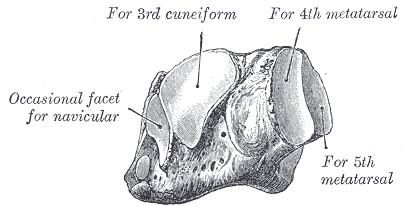
Gray's Anatomy (1918) plate, public domain
The cuboid is the cube-shaped tarsal on the outer side of the midfoot, between the heel bone behind and the fourth and fifth metatarsals in front. It forms the foundation of the foot's lateral arch and has a groove underneath for the fibularis longus tendon, which crosses the sole to support the arch from below.
Key facts
- The cuboid anchors the lateral (outer) column of the foot.
- It joins the calcaneus behind and the 4th and 5th metatarsals in front.
- Its groove carries the fibularis longus tendon across the sole.
- It also touches the navicular and the lateral cuneiform.
- It is part of the Lisfranc joint complex of the midfoot.
What can go wrong
The cuboid can be crushed in midfoot injuries (the rare 'nutcracker' fracture, squeezed between heel and metatarsals) and it can partly slip from its joints ('cuboid syndrome'), a cause of outer midfoot pain in dancers and runners that is often treated with manipulation and support.
Related procedures & tests
Related symptoms
Related muscles
Frequently asked questions
What does the cuboid do for the arch?
It is the keystone of the shorter, stiffer lateral arch, which acts as the foot's supporting edge; the fibularis longus tendon slings under it to brace both arches.
What is cuboid syndrome?
Pain over the cuboid thought to follow a slight positional fault or strain of its joints and ligaments, typically after an ankle sprain or in ballet dancers who work on pointe.
Educational information only. This atlas explains normal anatomy and describes conditions in general terms; it is not medical advice and does not replace assessment by a qualified clinician. If you have symptoms that worry you, seek medical care.