- Physical Examination
- Surgical Examination
- Ophthalmology
- Clinical Skills
- Orthopedics
- Surgery Videos
- Laparoscopy
- Pediatrics
- Funny Videos
- Cardiothoracic Surgery
- Nursing Videos
- Plastic Surgery
- Otorhinolaryngology
- Histology and Histopathology
- Neurosurgery
- Dermatology
- Pediatric Surgery
- Urology
- Dentistry
- Oncology and Cancers
- Anatomy Videos
- Health and Fitness
- Radiology
- Anaesthesia
- Physical Therapy
- Pharmacology
- Interventional Radiology
- Cardiology
- Endocrinology
- Gynecology
- Emergency Medicine
- Psychiatry and Psychology
- Childbirth Videos
- General Medical Videos
- Nephrology
- Physiology
- Diet and Food Health
- Diabetes Mellitus
- Neurology
- Women Health
- Osteoporosis
- Gastroenterology
- Pulmonology
- Hematology
- Rheumatology
- Toxicology
- Nuclear Medicine
- Infectious Diseases
- Vascular Disease
- Reproductive Health
- Burns and Wound Healing
- Kidney Zone Podcast
- Other
Ankle Joint
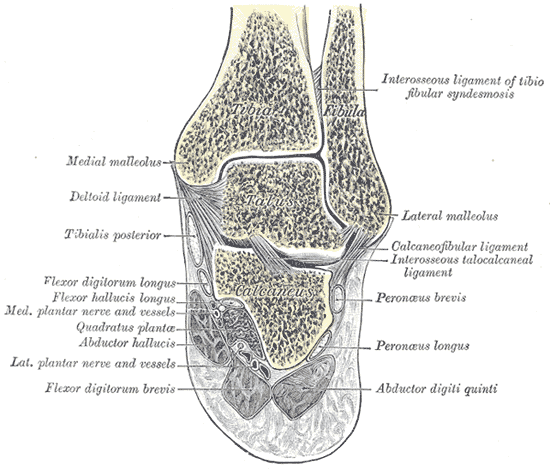
Gray's Anatomy (1918) plate, public domain
The ankle (talocrural joint) is the hinge between the leg bones and the talus of the foot: the tibia and fibula form a mortise (socket) that grips the talus, transmitting the body's weight into the foot. It mainly bends up (dorsiflexion) and down (plantarflexion); side-to-side movements come mostly from joints below it. Ligaments bind the mortise and guard against sprains — the lateral ligament complex on the outer side being the one most often torn.
Key facts
- The talus is wider at the front, so the joint is most stable when the foot is dorsiflexed (as in standing) — a bony wedge lock.
- The ankle carries the highest load per unit area of any joint, yet its cartilage resists arthritis better than the knee's.
- About 85% of ankle sprains involve the lateral (outer) ligaments from rolling the foot inward.
- The fibula bears only about a tenth of the weight but is crucial to the mortise's grip.
What can go wrong
Ankle sprains are among the commonest of all injuries; repeated sprains can leave chronic instability. Fractures involve the malleoli (the bony bumps) and need accurate realignment because the joint tolerates displacement poorly. Achilles tendon rupture affects the joint's main engine. Arthritis is usually post-traumatic here, unlike the hip and knee. Swelling, bruising patterns and the ability to bear weight guide whether X-rays are needed.
Related procedures & tests
Related symptoms
Related muscles
Frequently asked questions
Why do most sprains happen rolling the foot inward?
The inner ankle bone (medial malleolus) is shorter, letting the talus tilt inward more freely, and the lateral ligaments resisting it are comparatively slender.
When does an ankle injury need an X-ray?
Validated rules (Ottawa ankle rules) use tenderness at specific bony points and inability to bear weight to decide; pain only in the ligaments with normal weight-bearing usually means imaging is unnecessary.
Educational information only. This atlas explains normal anatomy and describes conditions in general terms; it is not medical advice and does not replace assessment by a qualified clinician. If you have symptoms that worry you, seek medical care.