- Physical Examination
- Surgical Examination
- Ophthalmology
- Clinical Skills
- Orthopedics
- Surgery Videos
- Laparoscopy
- Pediatrics
- Funny Videos
- Cardiothoracic Surgery
- Nursing Videos
- Plastic Surgery
- Otorhinolaryngology
- Histology and Histopathology
- Neurosurgery
- Dermatology
- Pediatric Surgery
- Urology
- Dentistry
- Oncology and Cancers
- Anatomy Videos
- Health and Fitness
- Radiology
- Anaesthesia
- Physical Therapy
- Pharmacology
- Interventional Radiology
- Cardiology
- Endocrinology
- Gynecology
- Emergency Medicine
- Psychiatry and Psychology
- Childbirth Videos
- General Medical Videos
- Nephrology
- Physiology
- Diet and Food Health
- Diabetes Mellitus
- Neurology
- Women Health
- Osteoporosis
- Gastroenterology
- Pulmonology
- Hematology
- Rheumatology
- Toxicology
- Nuclear Medicine
- Infectious Diseases
- Vascular Disease
- Reproductive Health
- Burns and Wound Healing
- Kidney Zone Podcast
- Other
Femoral Nerve
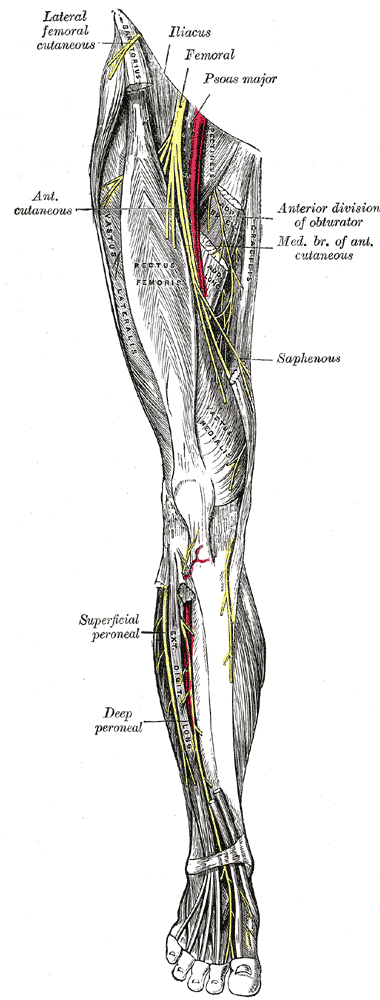
Gray's Anatomy (1918) plate, public domain
The femoral nerve, formed from the lumbar roots L2-4, is the main nerve of the front of the thigh. It emerges from the psoas muscle, passes under the groin ligament just lateral to the femoral artery, and divides to supply the quadriceps (knee extension), the hip flexors and sensation over the front and inner thigh and — via its saphenous branch — the inner leg and foot. It drives the knee jerk reflex.
Key facts
- Its saphenous branch is the longest purely sensory nerve branch in the body, running to the inner ankle.
- The groin order from lateral to medial is: Nerve, Artery, Vein (remembered as NAVY).
- Knee extension for walking and climbing stairs depends on this nerve more than any other.
- Anaesthetists block it in the groin to numb the thigh and knee for surgery and injury care.
What can go wrong
Femoral nerve damage — from pelvic or groin surgery, haematoma in the psoas (especially on blood thinners), diabetes or compression — causes quadriceps weakness (the knee giving way, difficulty with stairs), a lost knee jerk and numbness over the front thigh and inner leg. It must be distinguished from L2-4 root problems and from the lateral cutaneous nerve's purely sensory entrapment (meralgia paraesthetica, causing outer-thigh burning).
Related conditions
Related procedures & tests
Related symptoms
Related muscles
Frequently asked questions
What movement is lost with femoral nerve injury?
Mainly straightening the knee (quadriceps) and some hip flexion — making stairs and rising from a chair hard — with numbness over the front of the thigh and inner leg.
What is meralgia paraesthetica?
Entrapment of a neighbouring purely sensory nerve (lateral cutaneous nerve of the thigh) under the groin ligament, causing burning and numbness over the outer thigh without weakness.
Educational information only. This atlas explains normal anatomy and describes conditions in general terms; it is not medical advice and does not replace assessment by a qualified clinician. If you have symptoms that worry you, seek medical care.