- Physical Examination
- Surgical Examination
- Ophthalmology
- Clinical Skills
- Orthopedics
- Surgery Videos
- Laparoscopy
- Pediatrics
- Funny Videos
- Cardiothoracic Surgery
- Nursing Videos
- Plastic Surgery
- Otorhinolaryngology
- Histology and Histopathology
- Neurosurgery
- Dermatology
- Pediatric Surgery
- Urology
- Dentistry
- Oncology and Cancers
- Anatomy Videos
- Health and Fitness
- Radiology
- Anaesthesia
- Physical Therapy
- Pharmacology
- Interventional Radiology
- Cardiology
- Endocrinology
- Gynecology
- Emergency Medicine
- Psychiatry and Psychology
- Childbirth Videos
- General Medical Videos
- Nephrology
- Physiology
- Diet and Food Health
- Diabetes Mellitus
- Neurology
- Women Health
- Osteoporosis
- Gastroenterology
- Pulmonology
- Hematology
- Rheumatology
- Toxicology
- Nuclear Medicine
- Infectious Diseases
- Vascular Disease
- Reproductive Health
- Burns and Wound Healing
- Kidney Zone Podcast
- Other
Malleus
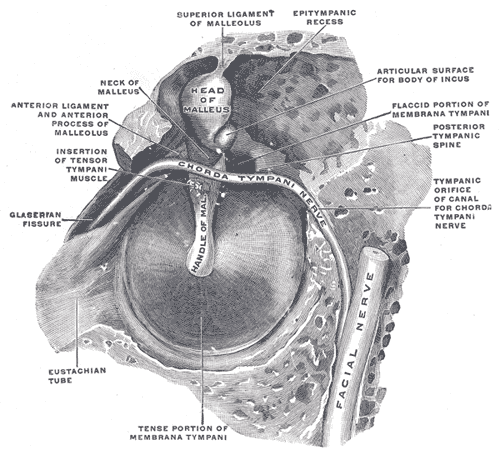
Gray's Anatomy (1918) plate, public domain
The malleus — Latin for 'hammer' — is the largest of the three tiny bones (ossicles) of the middle ear. Its handle is attached to the eardrum, and its head joins the incus. When sound moves the eardrum, the malleus carries the vibration onwards towards the inner ear.
Key facts
- The malleus is attached directly to the inner surface of the eardrum.
- It is the first of the three ossicles to move when sound arrives.
- Together the ossicles amplify the pressure of sound vibrations.
- A small muscle (tensor tympani) attaches to it and can dampen loud sounds.
- Despite the name, it is only about 8 millimetres long.
What can go wrong
The ossicles can be affected by otosclerosis — abnormal stiffening of the chain that causes gradual hearing loss — and by long-standing middle-ear infections, which can erode them. Injury to the ear can dislocate the chain. Hearing tests and ear examination help identify ossicle problems.
Related procedures & tests
Related symptoms
Frequently asked questions
How do three tiny bones improve hearing?
They act as a lever system and concentrate the eardrum's movement onto the much smaller window of the inner ear, boosting pressure so that sound passes efficiently from air into the fluid of the inner ear.
Can the ossicles be repaired?
Yes. Ear surgeons can sometimes free a stiffened chain or replace a damaged ossicle with a tiny prosthesis (ossiculoplasty) to improve hearing.
Educational information only. This atlas explains normal anatomy and describes conditions in general terms; it is not medical advice and does not replace assessment by a qualified clinician. If you have symptoms that worry you, seek medical care.