- Physical Examination
- Surgical Examination
- Ophthalmology
- Clinical Skills
- Orthopedics
- Surgery Videos
- Laparoscopy
- Pediatrics
- Funny Videos
- Cardiothoracic Surgery
- Nursing Videos
- Plastic Surgery
- Otorhinolaryngology
- Histology and Histopathology
- Neurosurgery
- Dermatology
- Pediatric Surgery
- Urology
- Dentistry
- Oncology and Cancers
- Anatomy Videos
- Health and Fitness
- Radiology
- Anaesthesia
- Physical Therapy
- Pharmacology
- Interventional Radiology
- Cardiology
- Endocrinology
- Gynecology
- Emergency Medicine
- Psychiatry and Psychology
- Childbirth Videos
- General Medical Videos
- Nephrology
- Physiology
- Diet and Food Health
- Diabetes Mellitus
- Neurology
- Women Health
- Osteoporosis
- Gastroenterology
- Pulmonology
- Hematology
- Rheumatology
- Toxicology
- Nuclear Medicine
- Infectious Diseases
- Vascular Disease
- Reproductive Health
- Burns and Wound Healing
- Kidney Zone Podcast
- Other
Second Metatarsal
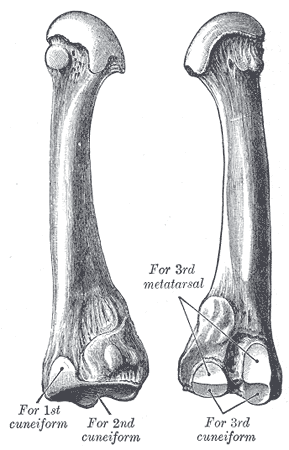
Gray's Anatomy (1918) plate, public domain
The second metatarsal is the longest metatarsal, and its base is wedged deep into the midfoot between the cuneiforms — the keystone arrangement of the Lisfranc joint. That rigidity makes it a common site for stress fractures, and its head is the one most often involved in Freiberg's disease, a softening of the bone in adolescents.
Key facts
- It is the longest metatarsal.
- Its recessed base is the midfoot's keystone.
- It is the metatarsal most prone to stress fracture.
- Its head can be overloaded when the first ray is short or stiff.
- It barely moves at its base — by design.
What can go wrong
Stress fractures of the second metatarsal shaft are common in runners, dancers and recruits, causing forefoot pain that builds with activity. Freiberg's disease — loss of blood supply to its head, usually in teenage girls — causes pain and stiffness at the second toe joint.
Related procedures & tests
Related symptoms
Frequently asked questions
Why does the second metatarsal take so much load?
It is the longest and the most rigidly fixed, so it cannot yield when the forefoot loads; a short or hypermobile first ray shifts even more force onto it.
What is Freiberg's disease?
A condition of adolescence in which the head of (usually) the second metatarsal loses its blood supply and flattens, causing ache and stiffness under the second toe.
Educational information only. This atlas explains normal anatomy and describes conditions in general terms; it is not medical advice and does not replace assessment by a qualified clinician. If you have symptoms that worry you, seek medical care.