- Physical Examination
- Surgical Examination
- Ophthalmology
- Clinical Skills
- Orthopedics
- Surgery Videos
- Laparoscopy
- Pediatrics
- Funny Videos
- Cardiothoracic Surgery
- Nursing Videos
- Plastic Surgery
- Otorhinolaryngology
- Histology and Histopathology
- Neurosurgery
- Dermatology
- Pediatric Surgery
- Urology
- Dentistry
- Oncology and Cancers
- Anatomy Videos
- Health and Fitness
- Radiology
- Anaesthesia
- Physical Therapy
- Pharmacology
- Interventional Radiology
- Cardiology
- Endocrinology
- Gynecology
- Emergency Medicine
- Psychiatry and Psychology
- Childbirth Videos
- General Medical Videos
- Nephrology
- Physiology
- Diet and Food Health
- Diabetes Mellitus
- Neurology
- Women Health
- Osteoporosis
- Gastroenterology
- Pulmonology
- Hematology
- Rheumatology
- Toxicology
- Nuclear Medicine
- Infectious Diseases
- Vascular Disease
- Reproductive Health
- Burns and Wound Healing
- Kidney Zone Podcast
- Other
Cochlea
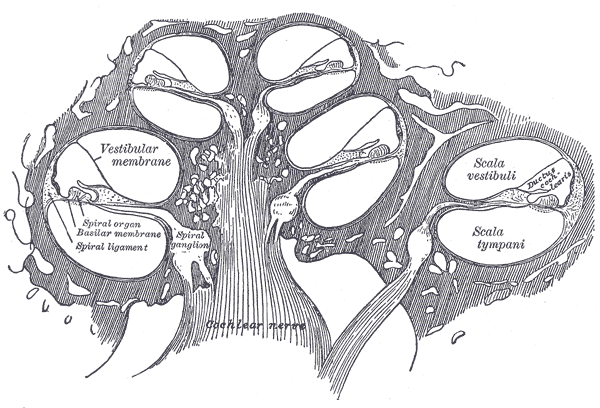
Gray's Anatomy (1918) plate, public domain
The cochlea is the hearing organ of the inner ear: a snail-shaped, fluid-filled spiral of about two and a half turns, no bigger than a pea, set in the temporal bone. Sound vibrations entering via the eardrum and ossicles ripple the fluid along its length; the ripples flex a membrane whose 15,000 hair cells convert them into nerve signals, sorted by pitch — high notes at the base, low notes at the apex. The auditory nerve carries the signals to the brain.
Key facts
- Hair cells are not replaced when lost — hearing damage from noise or ageing is permanent, though aids and implants can help.
- Each hair cell is tuned to a narrow frequency band, like keys on a piano laid out along the spiral.
- The cochlea amplifies faint sounds actively: outer hair cells change length to sharpen the response.
- It begins working before birth — babies respond to sound in the womb in the third trimester.
What can go wrong
Most hearing loss arises in the cochlea: age-related degeneration (presbycusis), noise injury, certain medicines and infections, and Ménière's disease with its episodic vertigo, tinnitus and fluctuating loss. Sudden sensorineural hearing loss is an emergency needing same-day ENT assessment. For profound cochlear loss, a cochlear implant can bypass the hair cells and stimulate the nerve electrically.
Related procedures & tests
Related symptoms
Related muscles
Frequently asked questions
Why does noise damage hearing permanently?
Loud sound over-flexes and eventually destroys the hair cells' bundles; since mammals do not regenerate cochlear hair cells, the loss at those pitches is irreversible.
What is a cochlear implant?
A device that converts sound to electrical signals delivered by an electrode array in the cochlea, directly stimulating the auditory nerve when hair cells no longer work.
Educational information only. This atlas explains normal anatomy and describes conditions in general terms; it is not medical advice and does not replace assessment by a qualified clinician. If you have symptoms that worry you, seek medical care.