- Physical Examination
- Surgical Examination
- Ophthalmology
- Clinical Skills
- Orthopedics
- Surgery Videos
- Laparoscopy
- Pediatrics
- Funny Videos
- Cardiothoracic Surgery
- Nursing Videos
- Plastic Surgery
- Otorhinolaryngology
- Histology and Histopathology
- Neurosurgery
- Dermatology
- Pediatric Surgery
- Urology
- Dentistry
- Oncology and Cancers
- Anatomy Videos
- Health and Fitness
- Radiology
- Anaesthesia
- Physical Therapy
- Pharmacology
- Interventional Radiology
- Cardiology
- Endocrinology
- Gynecology
- Emergency Medicine
- Psychiatry and Psychology
- Childbirth Videos
- General Medical Videos
- Nephrology
- Physiology
- Diet and Food Health
- Diabetes Mellitus
- Neurology
- Women Health
- Osteoporosis
- Gastroenterology
- Pulmonology
- Hematology
- Rheumatology
- Toxicology
- Nuclear Medicine
- Infectious Diseases
- Vascular Disease
- Reproductive Health
- Burns and Wound Healing
- Kidney Zone Podcast
- Other
Radial Nerve
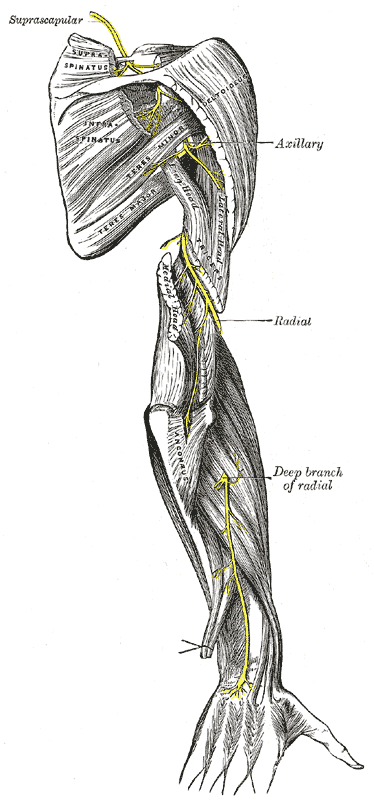
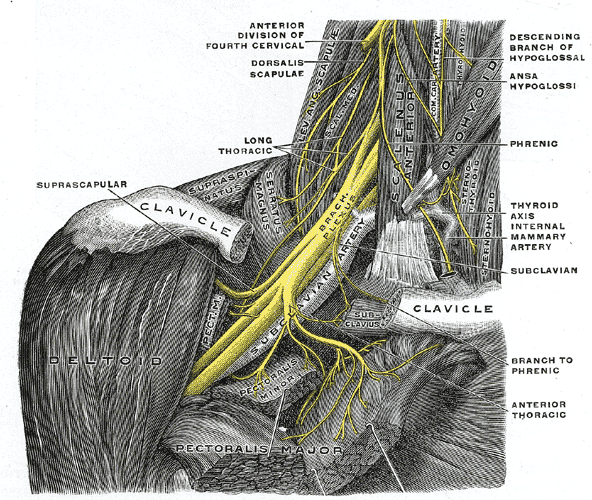
Gray's Anatomy (1918) plate, public domain
The radial nerve, the largest branch of the brachial plexus, spirals around the back of the humerus in its own groove, then divides at the elbow to supply the extensor muscles of the forearm — the muscles that lift the wrist and straighten the fingers — plus sensation over the back of the hand and forearm. It is the nerve of extension and of opening the hand, complementing the median and ulnar nerves' grip.
Key facts
- Its spiral course hugs the humerus, which is why mid-shaft arm fractures are its classic injury.
- It gives the triceps its supply before entering the spiral groove — so groove injuries spare elbow extension.
- Its superficial sensory branch at the wrist can be irritated by tight watch straps or handcuffs.
- Wrist drop is its signature deficit: the hand hangs limp because the extensors are paralysed.
What can go wrong
The classic injury is 'Saturday night palsy' — compression of the nerve in the spiral groove after falling asleep with the arm draped over a chair — causing wrist drop that usually recovers over weeks. Humerus fractures, elbow injuries and compression of its deep branch (posterior interosseous nerve) are other causes. Assessment distinguishes nerve levels by which muscles and skin areas are affected.
Related procedures & tests
Related symptoms
Related muscles
Frequently asked questions
Why does wrist drop happen?
The radial nerve powers all the muscles that extend the wrist; when it fails, the flexors act unopposed and the hand droops, also weakening grip because grip is strongest with the wrist held extended.
How long does Saturday night palsy take to recover?
When the injury is pure compression (neuropraxia), recovery is usually complete over several weeks as the nerve's insulation repairs; deeper injuries take longer and are followed with clinical and electrical tests.
Educational information only. This atlas explains normal anatomy and describes conditions in general terms; it is not medical advice and does not replace assessment by a qualified clinician. If you have symptoms that worry you, seek medical care.