- Physical Examination
- Surgical Examination
- Ophthalmology
- Clinical Skills
- Orthopedics
- Surgery Videos
- Laparoscopy
- Pediatrics
- Funny Videos
- Cardiothoracic Surgery
- Nursing Videos
- Plastic Surgery
- Otorhinolaryngology
- Histology and Histopathology
- Neurosurgery
- Dermatology
- Pediatric Surgery
- Urology
- Dentistry
- Oncology and Cancers
- Anatomy Videos
- Health and Fitness
- Radiology
- Anaesthesia
- Physical Therapy
- Pharmacology
- Interventional Radiology
- Cardiology
- Endocrinology
- Gynecology
- Emergency Medicine
- Psychiatry and Psychology
- Childbirth Videos
- General Medical Videos
- Nephrology
- Physiology
- Diet and Food Health
- Diabetes Mellitus
- Neurology
- Women Health
- Osteoporosis
- Gastroenterology
- Pulmonology
- Hematology
- Rheumatology
- Toxicology
- Nuclear Medicine
- Infectious Diseases
- Vascular Disease
- Reproductive Health
- Burns and Wound Healing
- Kidney Zone Podcast
- Other
Scapula
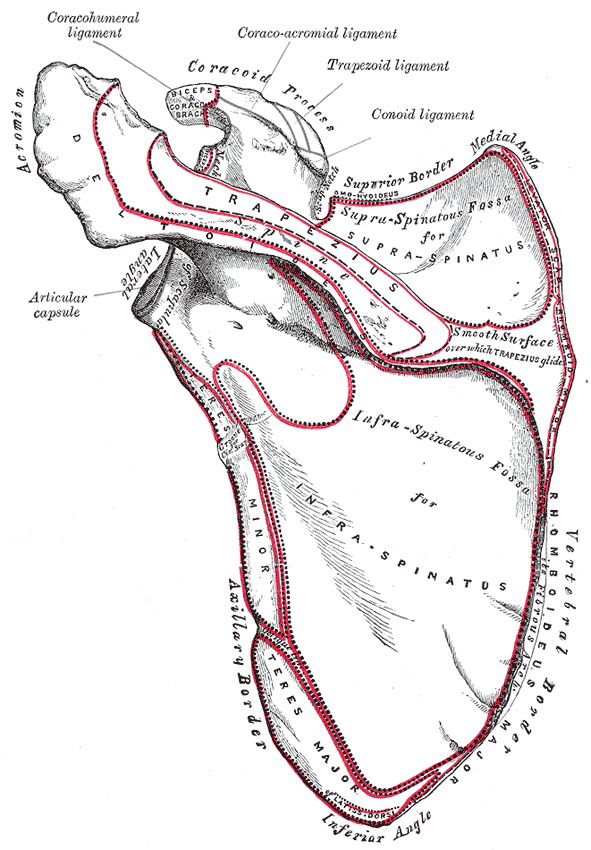
Gray's Anatomy (1918) plate, public domain
The scapula, or shoulder blade, is a flat triangular bone lying over the back of the ribs. Its small, shallow socket (the glenoid) forms the shoulder joint with the humerus; its spine rises into the acromion — the bony point of the shoulder — and its coracoid process hooks forwards. Seventeen muscles attach to it, making it the mobile base from which the arm works.
Key facts
- The scapula's glenoid socket is shallow, trading stability for the shoulder's huge range of movement.
- The acromion forms the bony tip of the shoulder and protects the joint from above.
- The spine of the scapula divides the trapezius and deltoid territories on the back.
- It glides over the rib cage on a cushion of muscle (the scapulothoracic joint).
- It has no direct bony joint with the trunk — only the clavicle links it.
What can go wrong
Scapula fractures are uncommon and imply a major force, because the bone is well padded with muscle. More often the scapula is involved through its socket in shoulder dislocations, or its movement pattern changes with shoulder pain ('scapular dyskinesis'). A winged scapula — the inner edge lifting off the chest — signals weakness of the serratus anterior muscle or its nerve.
Related procedures & tests
Related symptoms
Related muscles
- Trapezius
- Serratus Anterior
- Deltoid
- Supraspinatus
- Infraspinatus
- Subscapularis
- Rhomboid Major
- Levator Scapulae
Watch: related videos
Frequently asked questions
Why is the shoulder socket so shallow?
The glenoid is like a golf tee: it sacrifices stability so the arm can move in almost every direction. The joint depends on muscles (the rotator cuff) and ligaments, rather than bony fit, to stay in place.
What is a winged scapula?
When the muscle that holds the shoulder blade flat against the ribs (serratus anterior) is weak, the blade's inner edge sticks out like a small wing when pushing against a wall.
Educational information only. This atlas explains normal anatomy and describes conditions in general terms; it is not medical advice and does not replace assessment by a qualified clinician. If you have symptoms that worry you, seek medical care.