- Physical Examination
- Surgical Examination
- Ophthalmology
- Clinical Skills
- Orthopedics
- Surgery Videos
- Laparoscopy
- Pediatrics
- Funny Videos
- Cardiothoracic Surgery
- Nursing Videos
- Plastic Surgery
- Otorhinolaryngology
- Histology and Histopathology
- Neurosurgery
- Dermatology
- Pediatric Surgery
- Urology
- Dentistry
- Oncology and Cancers
- Anatomy Videos
- Health and Fitness
- Radiology
- Anaesthesia
- Physical Therapy
- Pharmacology
- Interventional Radiology
- Cardiology
- Endocrinology
- Gynecology
- Emergency Medicine
- Psychiatry and Psychology
- Childbirth Videos
- General Medical Videos
- Nephrology
- Physiology
- Diet and Food Health
- Diabetes Mellitus
- Neurology
- Women Health
- Osteoporosis
- Gastroenterology
- Pulmonology
- Hematology
- Rheumatology
- Toxicology
- Nuclear Medicine
- Infectious Diseases
- Vascular Disease
- Reproductive Health
- Burns and Wound Healing
- Kidney Zone Podcast
- Other
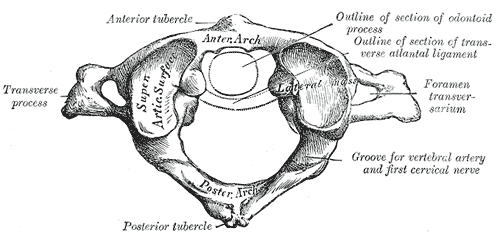
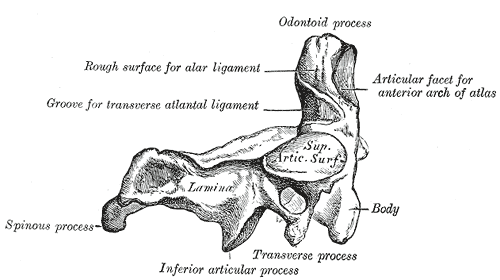
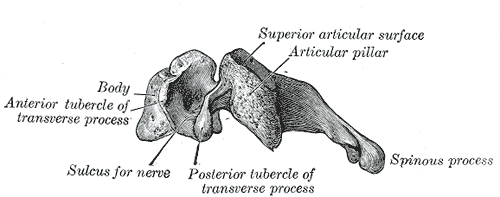
Typical Vertebra
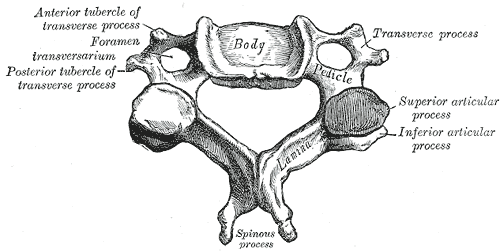
Gray's Anatomy (1918) plate, public domain
A typical vertebra has a drum-shaped body at the front that bears weight, and a bony arch behind it forming the canal for the spinal cord. Processes project from the arch: one backwards (the spinous process you can feel under the skin), two sideways for muscle and rib attachments, and smooth facets that form the small joints with the vertebrae above and below.
Key facts
- The vertebral body is the weight-bearing part and grows larger down the spine.
- The vertebral arch and body together enclose the spinal canal.
- The spinous process is the bump you feel when you run a finger down the back.
- Facet joints between vertebrae guide and limit the spine's movement.
- Holes at the sides (intervertebral foramina) let the spinal nerves exit.
What can go wrong
The small facet joints of the vertebrae can develop arthritis with age, contributing to back stiffness and pain. The vertebral body is the part weakened in osteoporosis and involved in compression fractures. A vertebra can slip forwards on the one below (spondylolisthesis), sometimes pinching the nerves that leave through the side openings.
Related procedures & tests
Related symptoms
Related muscles
Frequently asked questions
What is the knobbly ridge down the middle of the back?
Those are the spinous processes of the vertebrae, a line of bony levers for the back muscles, covered by skin and ligament. They are most obvious in the neck and upper back.
How do vertebrae differ from top to bottom?
They share the same basic plan but change with the load: neck vertebrae are small and mobile, chest vertebrae carry ribs, and the lower-back vertebrae are massive because they carry the weight of everything above them.
Educational information only. This atlas explains normal anatomy and describes conditions in general terms; it is not medical advice and does not replace assessment by a qualified clinician. If you have symptoms that worry you, seek medical care.