- Physical Examination
- Surgical Examination
- Ophthalmology
- Clinical Skills
- Orthopedics
- Surgery Videos
- Laparoscopy
- Pediatrics
- Funny Videos
- Cardiothoracic Surgery
- Nursing Videos
- Plastic Surgery
- Otorhinolaryngology
- Histology and Histopathology
- Neurosurgery
- Dermatology
- Pediatric Surgery
- Urology
- Dentistry
- Oncology and Cancers
- Anatomy Videos
- Health and Fitness
- Radiology
- Anaesthesia
- Physical Therapy
- Pharmacology
- Interventional Radiology
- Cardiology
- Endocrinology
- Gynecology
- Emergency Medicine
- Psychiatry and Psychology
- Childbirth Videos
- General Medical Videos
- Nephrology
- Physiology
- Diet and Food Health
- Diabetes Mellitus
- Neurology
- Women Health
- Osteoporosis
- Gastroenterology
- Pulmonology
- Hematology
- Rheumatology
- Toxicology
- Nuclear Medicine
- Infectious Diseases
- Vascular Disease
- Reproductive Health
- Burns and Wound Healing
- Kidney Zone Podcast
- Other
Esophagus
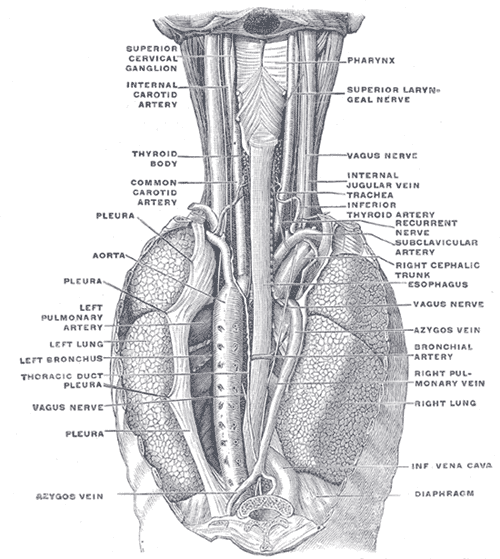
Gray's Anatomy (1918) plate, public domain
The esophagus is the muscular food pipe, about 25 cm long, carrying food and drink from the pharynx down through the chest to the stomach. It has no digestive role of its own: waves of muscle contraction (peristalsis) propel the bolus in seconds. Rings of muscle at its top (upper esophageal sphincter) and bottom (lower esophageal sphincter) keep it closed between swallows, the lower one guarding against stomach acid washing back up.
Key facts
- A swallowed bolus reaches the stomach in roughly 5-8 seconds, even if you are upside down, thanks to peristalsis.
- The esophagus passes through the diaphragm just in front of the spine.
- Its lining is built to withstand friction from food, not acid — which is why reflux burns it.
- It lies directly behind the windpipe and the left atrium of the heart, relations that matter in imaging and surgery.
What can go wrong
The commonest esophageal complaint is acid reflux (heartburn) when the lower sphincter lets stomach contents back up; long-standing reflux can change the lining (Barrett's esophagus). Swallowing difficulty (dysphagia) can come from narrowing (strictures), rings, inflammation from allergy (eosinophilic esophagitis) or tumours, and is investigated with endoscopy or barium studies. Spasm of its muscles can mimic heart-related chest pain.
Related conditions
Related procedures & tests
Related symptoms
Frequently asked questions
How long does food spend in the esophagus?
Only seconds. Peristaltic waves sweep solids down in about 5-8 seconds; liquids may run ahead under gravity even faster.
Why does reflux feel like burning?
Stomach acid splashing onto the esophageal lining irritates it because, unlike the stomach, it has no protective barrier designed for acid contact.
Educational information only. This atlas explains normal anatomy and describes conditions in general terms; it is not medical advice and does not replace assessment by a qualified clinician. If you have symptoms that worry you, seek medical care.