- Physical Examination
- Surgical Examination
- Ophthalmology
- Clinical Skills
- Orthopedics
- Surgery Videos
- Laparoscopy
- Pediatrics
- Funny Videos
- Cardiothoracic Surgery
- Nursing Videos
- Plastic Surgery
- Otorhinolaryngology
- Histology and Histopathology
- Neurosurgery
- Dermatology
- Pediatric Surgery
- Urology
- Dentistry
- Oncology and Cancers
- Anatomy Videos
- Health and Fitness
- Radiology
- Anaesthesia
- Physical Therapy
- Pharmacology
- Interventional Radiology
- Cardiology
- Endocrinology
- Gynecology
- Emergency Medicine
- Psychiatry and Psychology
- Childbirth Videos
- General Medical Videos
- Nephrology
- Physiology
- Diet and Food Health
- Diabetes Mellitus
- Neurology
- Women Health
- Osteoporosis
- Gastroenterology
- Pulmonology
- Hematology
- Rheumatology
- Toxicology
- Nuclear Medicine
- Infectious Diseases
- Vascular Disease
- Reproductive Health
- Burns and Wound Healing
- Kidney Zone Podcast
- Other
Placenta
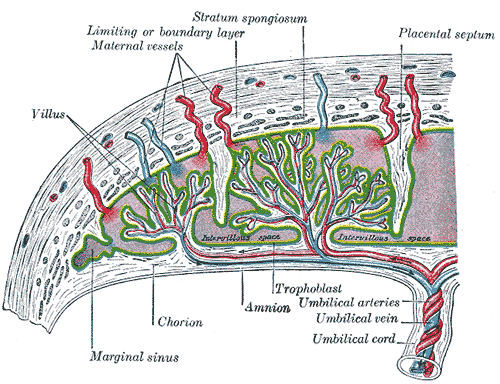
Gray's Anatomy (1918) plate, public domain
The placenta is the temporary organ that forms in the uterus during pregnancy, anchoring to the uterine wall and connecting to the baby through the umbilical cord. Across its thin barrier the baby receives oxygen and nutrients and offloads waste, without the two bloodstreams mixing. It also produces hormones that maintain pregnancy and influence the mother's metabolism, insulin sensitivity and blood vessels. It is delivered shortly after the baby.
Key facts
- At term the placenta is a disc about 20 cm across and 500-600 g, with a fetal surface from which the cord arises.
- Maternal blood bathes the placental villi directly; fetal blood stays inside its own vessels in the villi.
- It makes hCG — the hormone detected by pregnancy tests — plus progesterone, estrogen and placental lactogen.
- Cells from the baby cross into the mother in tiny numbers and can persist for decades (microchimerism).
What can go wrong
Placental problems include a low-lying placenta or placenta previa (covering the cervix, risking bleeding), premature separation (abruption), and poor function causing slow fetal growth (placental insufficiency). Abnormally deep attachment (placenta accreta spectrum) complicates delivery, especially after previous caesarean births. Position and growth are monitored on pregnancy ultrasound scans.
Related conditions
Related procedures & tests
Frequently asked questions
Do the mother's and baby's blood mix in the placenta?
No. Exchange happens across a thin membrane: oxygen, nutrients and waste cross between the two separate circulations without the bloods mixing.
What happens to the placenta after birth?
It separates from the uterine wall in the third stage of labour and is delivered; clinicians inspect it to confirm it is complete, since retained fragments can cause bleeding or infection.
Educational information only. This atlas explains normal anatomy and describes conditions in general terms; it is not medical advice and does not replace assessment by a qualified clinician. If you have symptoms that worry you, seek medical care.