- Physical Examination
- Surgical Examination
- Ophthalmology
- Clinical Skills
- Orthopedics
- Surgery Videos
- Laparoscopy
- Pediatrics
- Funny Videos
- Cardiothoracic Surgery
- Nursing Videos
- Plastic Surgery
- Otorhinolaryngology
- Histology and Histopathology
- Neurosurgery
- Dermatology
- Pediatric Surgery
- Urology
- Dentistry
- Oncology and Cancers
- Anatomy Videos
- Health and Fitness
- Radiology
- Anaesthesia
- Physical Therapy
- Pharmacology
- Interventional Radiology
- Cardiology
- Endocrinology
- Gynecology
- Emergency Medicine
- Psychiatry and Psychology
- Childbirth Videos
- General Medical Videos
- Nephrology
- Physiology
- Diet and Food Health
- Diabetes Mellitus
- Neurology
- Women Health
- Osteoporosis
- Gastroenterology
- Pulmonology
- Hematology
- Rheumatology
- Toxicology
- Nuclear Medicine
- Infectious Diseases
- Vascular Disease
- Reproductive Health
- Burns and Wound Healing
- Kidney Zone Podcast
- Other
Sciatic Nerve
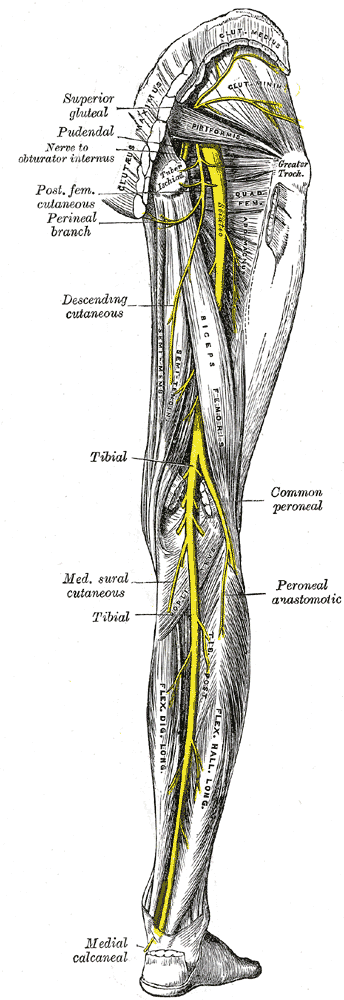
Gray's Anatomy (1918) plate, public domain
The sciatic nerve is the body's largest nerve — as wide as a thumb — formed from the lower lumbar and sacral roots (L4-S3). It leaves the pelvis through the greater sciatic foramen, usually below the piriformis muscle, crosses the buttock and runs down the back of the thigh, supplying the hamstrings and everything below the knee (directly or via its two terminal branches, the tibial and common fibular/peroneal nerves). It carries both movement and sensation for most of the leg.
Key facts
- At about 2 cm wide and up to a metre long in tall people, it is the largest and longest single nerve in the body.
- Its two components (tibial and common fibular) travel in one sheath and can be injured separately.
- The surface landmark for its buttock course — midway between the ischial tuberosity and the hip's greater trochanter — guides safe injection sites.
- Foot drop follows injury to its fibular division, which lifts the foot at the ankle.
What can go wrong
True sciatica is pain radiating down the nerve's path from buttock to foot, usually from a prolapsed lumbar disc pressing on one of its roots, often with numbness or weakness. The nerve itself can be injured by hip fractures, dislocations, injections or prolonged compression, and mimicked by piriformis syndrome in the buttock. Assessment checks power, reflexes and sensation in its territory; most disc-related sciatica improves with time and conservative care.
Related procedures & tests
Related symptoms
Related muscles
Watch: related videos
Frequently asked questions
What is the difference between sciatica and a sciatic nerve injury?
Sciatica is the symptom pattern — pain along the nerve's course — usually caused by pressure on its spinal roots from a disc; direct nerve injury is rarer and follows trauma, injections or surgery in the buttock or hip.
Why does a slipped disc in the back hurt the foot?
The nerve roots forming the sciatic nerve exit the lower spine; a prolapsed disc pressing a root makes the brain perceive pain along that root's whole territory, down to the foot.
Educational information only. This atlas explains normal anatomy and describes conditions in general terms; it is not medical advice and does not replace assessment by a qualified clinician. If you have symptoms that worry you, seek medical care.