- Physical Examination
- Surgical Examination
- Ophthalmology
- Clinical Skills
- Orthopedics
- Surgery Videos
- Laparoscopy
- Pediatrics
- Funny Videos
- Cardiothoracic Surgery
- Nursing Videos
- Plastic Surgery
- Otorhinolaryngology
- Histology and Histopathology
- Neurosurgery
- Dermatology
- Pediatric Surgery
- Urology
- Dentistry
- Oncology and Cancers
- Anatomy Videos
- Health and Fitness
- Radiology
- Anaesthesia
- Physical Therapy
- Pharmacology
- Interventional Radiology
- Cardiology
- Endocrinology
- Gynecology
- Emergency Medicine
- Psychiatry and Psychology
- Childbirth Videos
- General Medical Videos
- Nephrology
- Physiology
- Diet and Food Health
- Diabetes Mellitus
- Neurology
- Women Health
- Osteoporosis
- Gastroenterology
- Pulmonology
- Hematology
- Rheumatology
- Toxicology
- Nuclear Medicine
- Infectious Diseases
- Vascular Disease
- Reproductive Health
- Burns and Wound Healing
- Kidney Zone Podcast
- Other
Spinal Cord
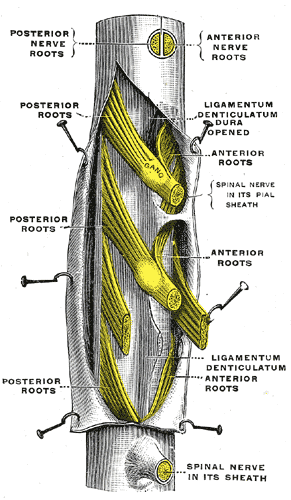
Gray's Anatomy (1918) plate, public domain
The spinal cord is the column of nervous tissue running from the brainstem down the vertebral canal to about the level of the first lumbar vertebra. About 45 centimetres long and as thick as a finger, it carries signals between brain and body and organises reflexes locally. Below its end, the canal contains the loose bundle of nerve roots called the cauda equina.
Key facts
- The spinal cord has 31 segments, each giving off a pair of spinal nerves.
- Its inner grey matter is butterfly-shaped, surrounded by white-matter tracts.
- It is protected by the vertebrae, the meninges and cerebrospinal fluid.
- Reflex arcs, such as the knee jerk, are completed within the cord itself.
- The cord ends in adults around L1-L2 — the reason lumbar punctures are done lower.
What can go wrong
Spinal cord injury from trauma can interrupt movement and feeling below the level of damage. The cord can also be compressed by disc prolapse, arthritis, tumours or bleeding — new leg weakness, saddle numbness or bladder and bowel changes with back pain need emergency assessment. Inflammation (myelitis) and diseases such as multiple sclerosis can also affect it.
Related conditions
Related procedures & tests
Related symptoms
Related muscles
Watch: related videos
Frequently asked questions
Why doesn't the spinal cord run the full length of the spine?
During growth the vertebral column lengthens faster than the cord, so the cord's end is 'left behind' at higher levels — in adults it finishes at about the first lumbar vertebra, with the nerve roots continuing downwards.
What is a reflex, in spinal cord terms?
A shortcut: sensory fibres entering the cord connect (directly or via interneurons) to motor neurons that fire a response without waiting for the brain — which is why a knee jerk happens before you have consciously felt the tap.
Educational information only. This atlas explains normal anatomy and describes conditions in general terms; it is not medical advice and does not replace assessment by a qualified clinician. If you have symptoms that worry you, seek medical care.