
- Physical Examination
- Surgical Examination
- Ophthalmology
- Clinical Skills
- Orthopedics
- Surgery Videos
- Laparoscopy
- Pediatrics
- Funny Videos
- Cardiothoracic Surgery
- Nursing Videos
- Plastic Surgery
- Otorhinolaryngology
- Histology and Histopathology
- Neurosurgery
- Dermatology
- Pediatric Surgery
- Urology
- Dentistry
- Oncology and Cancers
- Anatomy Videos
- Health and Fitness
- Radiology
- Anaesthesia
- Physical Therapy
- Pharmacology
- Interventional Radiology
- Cardiology
- Endocrinology
- Gynecology
- Emergency Medicine
- Psychiatry and Psychology
- Childbirth Videos
- General Medical Videos
- Nephrology
- Physiology
- Diet and Food Health
- Diabetes Mellitus
- Neurology
- Women Health
- Osteoporosis
- Gastroenterology
- Pulmonology
- Hematology
- Rheumatology
- Toxicology
- Nuclear Medicine
- Infectious Diseases
- Vascular Disease
- Reproductive Health
- Burns and Wound Healing
- Kidney Zone Podcast
- Other
SVT (Supraventricular Tachycardia) on an ECG
SVT is a fast rhythm starting above the heart's lower chambers, usually from a small electrical short-circuit, causing episodes of sudden racing palpitations. This page explains what SVT looks like on an ECG, why it happens, and how episodes are stopped, in plain language with videos.
✓ Medically reviewed by Dr. Mohamed Ibrahim, MD, PhD — physician-scientist · Last reviewed: November 2026
Watch: SVT (Supraventricular Tachycardia) on an ECG videos
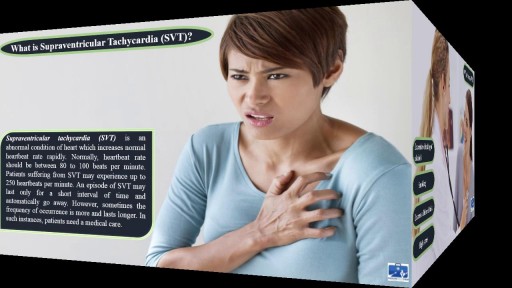 What is Supraventricular Tachycardia (SVT)9,603 views
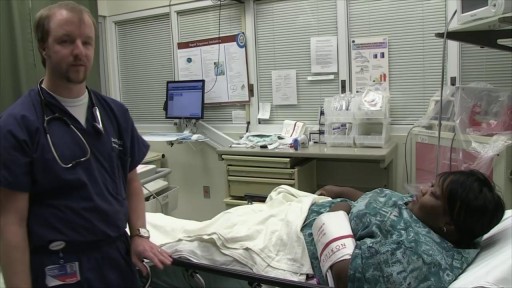 Treating SVT with Adenosine3,066 views
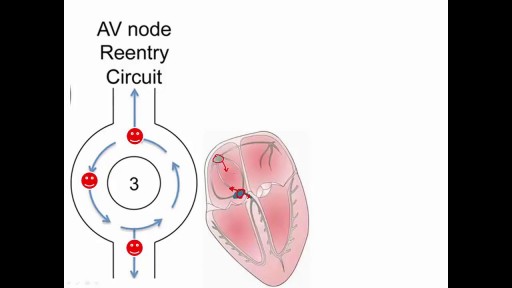 understanding supraventricular tachycardia or SVT2,211 views
Guide
What it is
Supraventricular tachycardia, or SVT, is a fast heart rhythm that starts above the lower chambers — in the upper chambers or the AV node. Episodes typically begin and end suddenly, like a switch being flipped, with the heart racing at a steady, rapid pace and the person feeling palpitations, light-headedness, or chest tightness. SVT is an umbrella term covering a few related circuits, which can look similar on a tracing. Between episodes the ECG is often completely normal, which is why capturing an episode matters.
What the tracing shows
The classic SVT tracing shows a fast rate with evenly spaced, narrow QRS complexes marching one after another. P waves are hard to find: the signal is looping so quickly that the P wave is often buried inside the QRS or appears as a small extra notch just after it. Comparing with an ECG taken when the heart is calm often reveals the difference. If the person also has a conduction block, SVT can produce wide complexes, which is one reason fast rhythms are assessed in person rather than from a single feature.
What it can mean
Most SVT comes from a short-circuit: an extra connection or a small loop in or near the AV node that lets the signal circle rapidly. Episodes are usually more frightening than dangerous in a structurally normal heart, but frequent or long episodes deserve treatment, and catheter ablation can cure many types by interrupting the circuit. Because a very fast wide-complex rhythm can also be ventricular tachycardia — which is more dangerous — clinicians treat uncertain cases cautiously until the tracing proves which it is.
When it is urgent
An episode that does not settle within a short time, or any episode with chest pain, breathlessness, dizziness, or fainting, should be assessed urgently — in an emergency department if symptoms are significant. Simple vagal manoeuvres, such as straining as if lifting something heavy, sometimes stop an episode and may be suggested by your clinician. If episodes keep happening, keep a note of when, how long, and what you felt, and ask about longer monitoring to capture one on record.
Common questions
What are the main types of SVT?
The main types are AV nodal reentrant tachycardia (AVNRT), atrioventricular reentrant tachycardia (AVRT) using an extra connection, and focal atrial tachycardia. All are circuits or fast foci above the ventricles, and they can look very similar on an ECG.
How is an SVT episode stopped?
Many episodes stop with vagal manoeuvres — simple techniques such as bearing down that slow the AV node. Episodes that continue are treated in hospital with medicines or, if the person is unwell, a controlled electric shock.
Can SVT be cured?
Yes, often. Catheter ablation can find and interrupt the small circuit or extra connection causing SVT, and for many people it is a lasting cure. Regular medicines are the alternative.
Is sinus tachycardia a type of SVT?
Not usually. Sinus tachycardia speeds up and slows down gradually and follows a cause such as fever or pain, while SVT starts and stops suddenly, like a switch, often at a faster rate.
More in Rhythm Patterns
Related
Sources
- Heart Arrhythmia (MedlinePlus)
- Arrhythmia (British Heart Foundation)
- Electrocardiogram (ECG) test (MedlinePlus)
- About Heart Disease (CDC)
This guide is general information, not medical advice, and does not replace advice from your own clinician. ECG patterns should always be interpreted in context by a trained professional. If you have chest pain, severe breathlessness, fainting or a racing heartbeat that will not settle, seek urgent medical care. A fast regular rhythm has several possible causes; only a tracing recorded during the episode can confirm SVT, so episodes should be medically assessed.