- Physical Examination
- Surgical Examination
- Ophthalmology
- Clinical Skills
- Orthopedics
- Surgery Videos
- Laparoscopy
- Pediatrics
- Funny Videos
- Cardiothoracic Surgery
- Nursing Videos
- Plastic Surgery
- Otorhinolaryngology
- Histology and Histopathology
- Neurosurgery
- Dermatology
- Pediatric Surgery
- Urology
- Dentistry
- Oncology and Cancers
- Anatomy Videos
- Health and Fitness
- Radiology
- Anaesthesia
- Physical Therapy
- Pharmacology
- Interventional Radiology
- Cardiology
- Endocrinology
- Gynecology
- Emergency Medicine
- Psychiatry and Psychology
- Childbirth Videos
- General Medical Videos
- Nephrology
- Physiology
- Diet and Food Health
- Diabetes Mellitus
- Neurology
- Women Health
- Osteoporosis
- Gastroenterology
- Pulmonology
- Hematology
- Rheumatology
- Toxicology
- Nuclear Medicine
- Infectious Diseases
- Vascular Disease
- Reproductive Health
- Burns and Wound Healing
- Kidney Zone Podcast
- Other
Joints
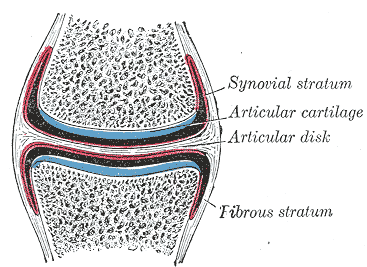
Gray's Anatomy (1918) plate, public domain
Joints are the connections between bones, classified by how much movement they allow: fibrous joints (the skull's sutures — immovable), cartilaginous joints (the spine's discs — slightly movable) and synovial joints (freely movable, with a fluid-filled cavity, smooth hyaline cartilage and a ligament-reinforced capsule). Synovial joints come in hinge, ball-and-socket, pivot, saddle, condyloid and gliding forms, each trading mobility against stability.
Key facts
- Synovial fluid is an extraordinary lubricant — healthy joint friction is lower than ice on ice.
- Cartilage has no blood vessels or nerves; it is nourished by the pumping action of movement squeezing fluid in and out.
- The body's most mobile joint is the shoulder; its most stable ball-and-socket is the hip.
- Joint position sense (proprioception) comes from receptors in ligaments and capsules, feeding balance and coordination.
What can go wrong
Joint diseases are dominated by osteoarthritis (cartilage wear with pain and stiffness, strongly related to age, weight and previous injury), inflammatory arthritides such as rheumatoid and gout, infections (septic arthritis — an emergency), and injuries to the internal structures (ligaments, menisci, labra). Painful, swollen or locking joints are assessed by examination, X-ray and sometimes MRI or joint fluid sampling.
Related conditions
Related procedures & tests
- Joint aspiration (arthrocentesis)
- Arthroscopy (keyhole joint surgery)
- Joint injection (steroid)
- X-ray (general)
Related symptoms
Watch: related videos
Frequently asked questions
Why doesn't cartilage heal well?
It has no blood supply and few cells, so injuries cannot mount a repair response; damage tends to progress, which is why protecting joint cartilage matters.
What is the difference between osteoarthritis and rheumatoid arthritis?
Osteoarthritis is primarily cartilage wear with secondary bone change, usually in load-bearing joints; rheumatoid arthritis is an autoimmune inflammation of the joint lining that can damage many joints and other organs.
Educational information only. This atlas explains normal anatomy and describes conditions in general terms; it is not medical advice and does not replace assessment by a qualified clinician. If you have symptoms that worry you, seek medical care.