- Physical Examination
- Surgical Examination
- Ophthalmology
- Clinical Skills
- Orthopedics
- Surgery Videos
- Laparoscopy
- Pediatrics
- Funny Videos
- Cardiothoracic Surgery
- Nursing Videos
- Plastic Surgery
- Otorhinolaryngology
- Histology and Histopathology
- Neurosurgery
- Dermatology
- Pediatric Surgery
- Urology
- Dentistry
- Oncology and Cancers
- Anatomy Videos
- Health and Fitness
- Radiology
- Anaesthesia
- Physical Therapy
- Pharmacology
- Interventional Radiology
- Cardiology
- Endocrinology
- Gynecology
- Emergency Medicine
- Psychiatry and Psychology
- Childbirth Videos
- General Medical Videos
- Nephrology
- Physiology
- Diet and Food Health
- Diabetes Mellitus
- Neurology
- Women Health
- Osteoporosis
- Gastroenterology
- Pulmonology
- Hematology
- Rheumatology
- Toxicology
- Nuclear Medicine
- Infectious Diseases
- Vascular Disease
- Reproductive Health
- Burns and Wound Healing
- Kidney Zone Podcast
- Other
Retina
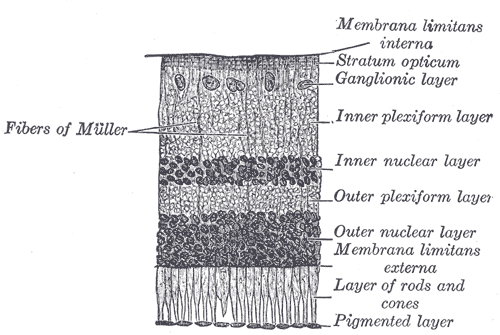
Gray's Anatomy (1918) plate, public domain
The retina is the thin, layered sheet of neural tissue lining the back of the eye. Its photoreceptors — rods for dim light and cones for colour and detail — convert light into electrical signals. The macula at its centre, with the fovea at its middle, provides sharp central vision; the optic disc, where the nerve leaves, has no receptors and creates the blind spot.
Key facts
- The retina is technically part of the brain, pushed out into the eye during development.
- Cones concentrate at the fovea — your sharpest vision covers about a thumbnail at arm's length.
- Rods dominate the periphery and handle night vision.
- Retinal blood vessels are the only ones in the body directly visible without surgery.
- The retina consumes oxygen at a very high rate for its size.
What can go wrong
Retinal problems include detachment (often heralded by flashes, new floaters or a shadow), macular degeneration affecting central vision in older adults, and damage from diabetes and high blood pressure visible in its vessels. Sudden visual symptoms are assessed the same day because a detached retina is time-critical.
Related procedures & tests
- Diabetic eye screening (retinal photography)
- OCT scan (optical coherence tomography)
- Fundus fluorescein angiography (FFA)
Related symptoms
Frequently asked questions
Why do doctors look at the retina to judge general health?
Its blood vessels reflect the state of vessels elsewhere: diabetes and high blood pressure leave characteristic marks there, and the optic disc can reveal raised pressure inside the skull.
What causes floaters?
Tiny clumps or strands in the vitreous gel casting shadows on the retina. They are usually a normal age change, but a sudden shower of new floaters with flashes needs same-day assessment for retinal tears.
Educational information only. This atlas explains normal anatomy and describes conditions in general terms; it is not medical advice and does not replace assessment by a qualified clinician. If you have symptoms that worry you, seek medical care.