- Physical Examination
- Surgical Examination
- Ophthalmology
- Clinical Skills
- Orthopedics
- Surgery Videos
- Laparoscopy
- Pediatrics
- Funny Videos
- Cardiothoracic Surgery
- Nursing Videos
- Plastic Surgery
- Otorhinolaryngology
- Histology and Histopathology
- Neurosurgery
- Dermatology
- Pediatric Surgery
- Urology
- Dentistry
- Oncology and Cancers
- Anatomy Videos
- Health and Fitness
- Radiology
- Anaesthesia
- Physical Therapy
- Pharmacology
- Interventional Radiology
- Cardiology
- Endocrinology
- Gynecology
- Emergency Medicine
- Psychiatry and Psychology
- Childbirth Videos
- General Medical Videos
- Nephrology
- Physiology
- Diet and Food Health
- Diabetes Mellitus
- Neurology
- Women Health
- Osteoporosis
- Gastroenterology
- Pulmonology
- Hematology
- Rheumatology
- Toxicology
- Nuclear Medicine
- Infectious Diseases
- Vascular Disease
- Reproductive Health
- Burns and Wound Healing
- Kidney Zone Podcast
- Other
Knee Joint
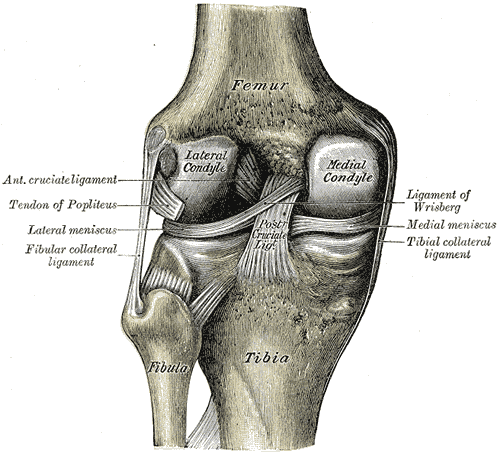
Gray's Anatomy (1918) plate, public domain
The knee is the body's largest joint — a modified hinge between femur, tibia and patella. Two crescent cartilages (menisci) deepen its shallow surfaces, four main ligaments stabilise it (the cruciates inside cross like an X, the collaterals on the sides), and the patella embedded in the quadriceps tendon multiplies the muscle's leverage. It bears enormous loads in walking, running and stairs, balanced by muscle control as much as by its structure.
Key facts
- The anterior cruciate ligament (ACL) is injured tens of thousands of times a year in sport, usually in twisting, non-contact landings.
- The menisci transmit about half the load across the knee; removing them raises cartilage stress and arthritis risk.
- Straightening the knee 'locks' it by a slight rotation, letting you stand with little muscle effort.
- Forces across the kneecap can reach several times body weight on stairs.
What can go wrong
Knee problems span every age: ligament and meniscus tears in the young and sporty (with swelling and instability), kneecap pain in adolescents and runners, and osteoarthritis in later life causing pain, stiffness and deformity, often helped by replacement surgery. Inflammatory arthritis, gout and infection also affect it. Because it is superficial, swelling, warmth and instability are readily examined; MRI clarifies internal injuries.
Related conditions
Related procedures & tests
Related symptoms
Related muscles
Frequently asked questions
What does the ACL do?
It stops the tibia sliding forward under the femur and controls rotation; when torn, the knee may give way on pivoting even though walking straight feels normal.
Why does the knee lock?
True locking — the knee stuck and unable to straighten — usually means something mechanical inside, most often a torn meniscus fragment flipped into the joint.
Educational information only. This atlas explains normal anatomy and describes conditions in general terms; it is not medical advice and does not replace assessment by a qualified clinician. If you have symptoms that worry you, seek medical care.