
- Procedures & Tests
- Symptoms A-Z
- Symptom Checker
- Kidney Diet
- First Aid
- Anatomy Atlas
- Ask MedicalVideos
- Drug Guide
- Lab Values
- Vital Signs
- Muscles A–Z
- Clinical Signs
- Medical Abbreviations
- Medical Terminology
- Physical Examination
- Surgical Examination
- Ophthalmology
- Clinical Skills
- Orthopedics
- Surgery Videos
- Laparoscopy
- Pediatrics
- Medical Humor
- Cardiothoracic Surgery
- Nursing Videos
- Plastic Surgery
- Otorhinolaryngology
- Histology and Histopathology
- Neurosurgery
- Dermatology
- Pediatric Surgery
- Urology
- Dentistry
- Oncology and Cancers
- Anatomy Videos
- Health and Fitness
- Radiology
- Anaesthesia
- Physical Therapy
- Pharmacology
- Interventional Radiology
- Cardiology
- Endocrinology
- Gynecology
- Emergency Medicine
- Psychiatry and Psychology
- Childbirth Videos
- General Medical Videos
- Nephrology
- Physiology
- Diet and Food Health
- Diabetes Mellitus
- Neurology
- Women Health
- Osteoporosis
- Gastroenterology
- Pulmonology
- Hematology
- Rheumatology
- Toxicology
- Nuclear Medicine
- Infectious Diseases
- Vascular Disease
- Reproductive Health
- Burns and Wound Healing
- Kidney Zone Podcast
- Other

Examen urológico masculino: en qué consiste un examen de urología
Surgeon. Male Urological Examination: What a Urology Exam Involves [video]. MedicalVideos.com; 2024 Jan 17 [cited 2026 Nov 29]. Available from: https://www.medicalvideos.com/watch/male-urological-examination-what-a-urology-exam-involves_0DwCOOX3jEOrYSiMiHic.html
Surgeon (2024, January 17). Male Urological Examination: What a Urology Exam Involves [Video]. MedicalVideos.com. https://www.medicalvideos.com/watch/male-urological-examination-what-a-urology-exam-involves_0DwCOOX3jEOrYSiMiHic.html
Surgeon. “Male Urological Examination: What a Urology Exam Involves.” MedicalVideos.com, 17 Jan. 2024, https://www.medicalvideos.com/watch/male-urological-examination-what-a-urology-exam-involves_0DwCOOX3jEOrYSiMiHic.html. Accessed 29 Nov. 2026.
@misc{medicalvideos2024_0DwCOOX3jEOrYSiMiHic,
  author = {Surgeon},
  title = {Male Urological Examination: What a Urology Exam Involves},
  publisher = {MedicalVideos.com},
  year = {2024},
  month = {1},
  url = {https://www.medicalvideos.com/watch/male-urological-examination-what-a-urology-exam-involves_0DwCOOX3jEOrYSiMiHic.html},
  note = {Video},
  urldate = {2026-11-29}
}Vancouver (NLM) is the manuscript standard for medical journals. RIS imports into EndNote, Zotero and Mendeley.

Educational only: videos on MedicalVideos.com are for general information and are not medical advice. Always consult your own doctor about your health.
Una demostración educativa de un examen urológico masculino, para pacientes y estudiantes que quieren saber qué esperar. Solo con fines educativos — no es consejo médico.
This video in 30 seconds
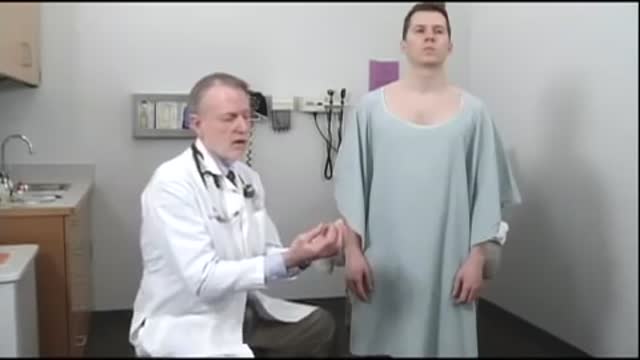
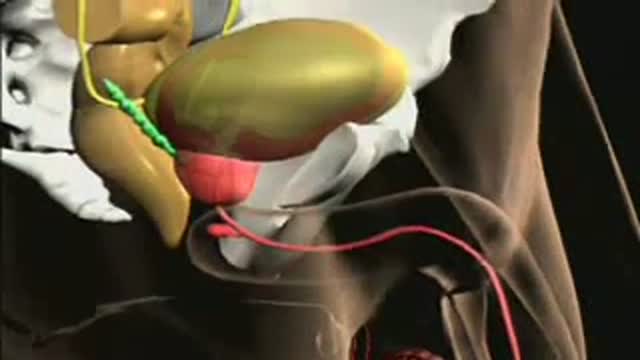
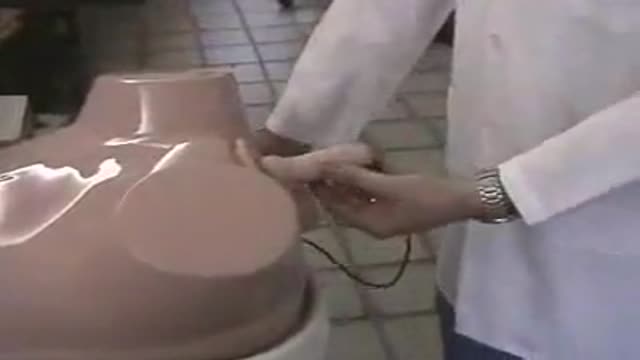
This teaching demonstration shows a complete male urological examination, with the examiner explaining each step to the patient as it happens. It begins with percussion over the kidneys at the costovertebral angles, continues through abdominal inspection and palpation, genital and testicular examination, and a hernia check, and finishes with a rectal examination of the prostate.
Key points
- Kidney percussion at the costovertebral angles opens the examination
- Abdominal inspection, percussion, and palpation cover the liver, kidneys, and bladder area
- The penis and scrotum are inspected for lesions or abnormalities
- Each testicle, the epididymis, and the spermatic cord structures are palpated
- A standing hernia check and a rectal examination of the prostate complete the assessment
Chapters
- 0:00 — Kidney examination at costovertebral angles
- 0:47 — Abdominal examination begins
- 3:05 — Inspection of penis and scrotum
- 4:28 — Examination of scrotum and testicles
- 5:47 — Standing hernia check
- 6:38 — Rectal examination of prostate
Ask this video
Ask about a step, a term, or a moment in this video. The answer is quoted from the video's own transcript — tap a timestamp to jump the player there.
Quoted from the auto-generated transcript, so an occasional word may be the transcript's own error. Educational only — not medical advice and not a diagnosis.
Chapters
Video Transcript
A complete teaching demonstration of the male urological examination, with the examiner explaining each step to the patient as it happens. It begins at the costovertebral angles — percussing over the kidneys and explaining what tenderness would suggest, such as pyelonephritis or hydronephrosis — and continues through the rest of the urological assessment in the same plain, step-by-step style.
Read the full transcript
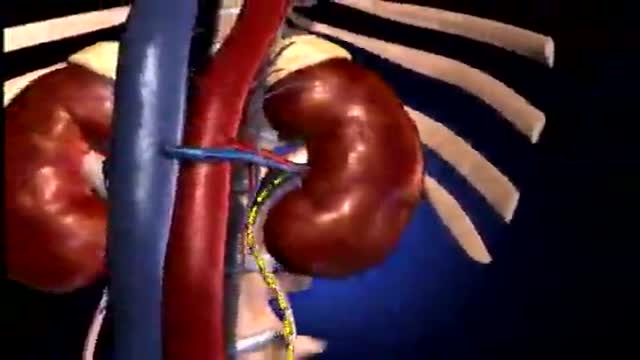
First part of the examination will be for me to check your kidneys. And I'll do that by examining what we call your costo vertebral angles. Costo refers to your ribs, which are here, and vertebral refers to your vertebrae, which are here, and they make an angle where the kidney is. And so I'll start simply by percussing or tapping on your kidneys. And I'll ask you if you feel any tenderness or pain when I do that. No. And I'll switch to the left side and tap here. You don't have to tap very hard, but just enough to shake the kidney a little bit.
And if you had pylonephritis, which is a kidney infection, or if you had hydronephrosis, which is a kidney obstruction, you'd be very tender when I tapped on the kidney that way. And now I'll ask you to lie flat on your back so that I can continue with the abdominal exam. The next part of the examination will involve your abdomen. And I'll do a typical abdominal examination. That'll involve checking your liver and your spleen, your kidneys, and your bladder. And I'll then move on and check your external genitals, which is your penis and your testicles.
So I'll start then by lifting up the gown and asking you to keep your arms at their sides where they are so that it loosens up your stomach muscles and makes the examination easier. And I'll start by inspecting and simply looking for asymmetry. And then I continue by percussing and then by palpating. And what I'm in particular looking at is the kidneys. The kidneys are difficult to palpate with their normal in size. However, if you had a mass of the kidneys, I would be able to feel that by applying pressure from behind and from in front.
And then I'll check the other side in a similar way by checking from behind and in front so that I kind of capture the kidney between my two hands. Again, I can't actually feel your kidneys now because they're nice and small and normal. But if there were a mass in your kidneys, I would probably be able to feel that. And then go on and feel the edge of your liver, which is just up inside your rib cage, where it should be, and then over here at your spleen, which I can't feel, which is a good thing.
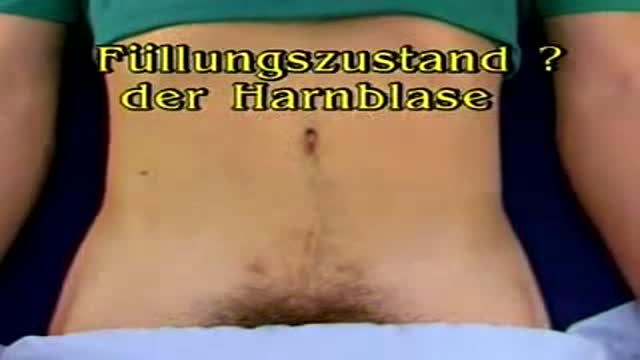
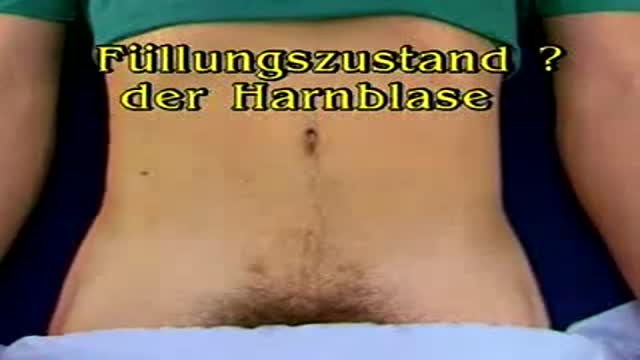
And then I'll move down and examine the lower part of your abdomen, which is where your bladder is. And if you've urinated recently, you don't have any fluid in your bladder, I shouldn't be able to feel it. So I'll start by percussing. And it does not sound like fluid, which means it doesn't sound like a dilated bladder with lots of urine in it. And then I'll palpate. And again, it feels nice and soft, and I actually can't feel your bladder, which is a good thing. If you were in chronic urinary retention, I'd be able to feel your bladder as a cystic-shaped structure in the lower abdomen.
I'll now continue with an examination of your penis and testicles. So I'll pull the down down little bit here. And I'll start simply by inspecting the penis and scrotum. I look for the presence of any lesions, of which there are none. But very carefully, the shaft of the penis on the right side, or on the left side. I see a small mole, which I suspect you've had there for many years, which is completely benign. And I'm looking for anything abnormal, which I see looks fine. I also make note of the fact that your penis is uncircumcised, which means that you have a foreskin here.
If you were circumcised, it would look more like that. But since you're uncircumcised, the foreskin hangs over, sort of like the sleeve on the end of a squirtle. And the foreskin itself, also known as the prepus, is nice and soft and healthy looking. So I'll examine very carefully on the head of the penis, the lesions of which there are none, a couple of freckles. And then we'll examine the shaft of the penis, the corpora of bodies, for the presence of any plaques of scar tissue that we would find in a condition called Peroni's disease.
And your corpora of bodies are nice and normal. We'll then examine the uric from theatus by gently spreading it apart and looking for an lesion such as condoloma. And your meatus looks normal. I'll continue by examining your scrotum and testicles. The scrotum is symmetrical, although it's normal for one testicle to hang lower than the other in some men. Now I'll start by first taking your right testicle, picking it up with one hand and capturing it, and then taking my other hand and passing it back and forth from one set of fingers to the other.
Feeling very carefully on the surface of the testicle, but taking care not to press too hard so that it's not uncomfortable. I'll also feel behind the testicle to the tube system called the epididymis, looking for cysts or masses, and your spills normal. And then switch to your left side and do the same thing over here, passing the testicle back and forth, feeling for any masses, and then posteriorly on the epididymis. Above the testicle is something called the spermatic cord, which you can actually feel, and that contains vital structures such as the spermatic artery and vein, nerves, muscle, fat tissue,
and the important vas deferens, which takes the sperm from the testicle up into the prostate to come out during ejaculation. That's what we taught when we do a vasectomy, and yours feel normal. Now I'd like to ask you to stand up so that I can check you for the presence of an inguinal hernia. What I'll do is place a finger into your inguinal canal right alongside your spermatic cord, just like that. Now I'll ask you to please turn your head to the right and give me a big strong cough. Very good.
Now stick the finger into the left inguinal canal along the spermatic cord, and again if you'll turn your head to the same direction and give me a big strong cough. Good. You don't have any sign of a hernia at all. If I did feel a hernia, I would feel the pressure of abdominal contents coming down onto my finger. Paul, I'd like for you to lean all the way over the edge of the bed, please, and put your elbows down onto the pad, let the gallon fall apart.
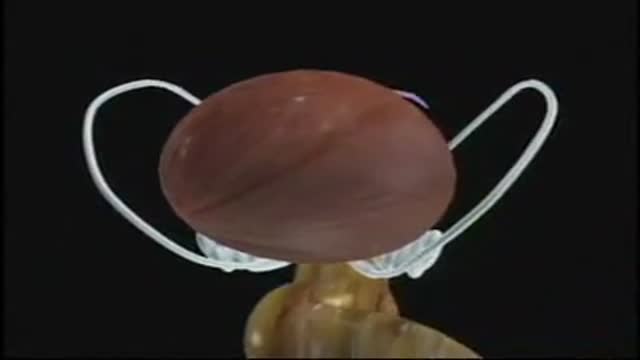
I'm now going to perform a rectal examination, and I'll start by putting a little bit of jelly on the backside. The first thing I do is to spread the cheeks of the buttocks apart a bit, place a little bit of cool jelly on the backside, and then you'll feel one finger gently being inserted into your rectum. Now I'll examine your prostate, first on the right side, then in the middle, and then on the left side, and it feels perfectly fine. An alternative way of examining the prostate is with you in what we call the fetal position, as you are now.
On your side, facing me, with your knees pulled up sort of close to your chest, and I can examine the prostate equally well in this position as I can in the leaning over position. So again, I'll start by first pulling the cheeks of the buttocks apart, placing a little bit of jelly on the backside, and then placing one finger gently into the rectum, and examining the prostate. And I can examine the prostate just as effectively in this position as I can when you're leaning over. And one of the other things I'm looking for when I do a rectal examination is for the presence of any rectal masses,
as well as for the strength of your anal sphincter, both of which are normal.
Transcript auto-generated from the video’s audio for accessibility and study. Educational content only — not medical advice.
Related reading
Save videos for later
Create a free account to build your own watch-later list and playlists, and pick up where you left off on any device.
Medical Videos
Free medical and surgery videos for patients, students and professionals — trusted since 2007.
Founded by Dr. Mohamed Ibrahim, MD, PhD — physician-scientist.
Follow us on Facebook · Instagram · Telegram
SORT BY-
Top Comments
-
Latest comments