- Physical Examination
- Surgical Examination
- Ophthalmology
- Clinical Skills
- Orthopedics
- Surgery Videos
- Laparoscopy
- Pediatrics
- Funny Videos
- Cardiothoracic Surgery
- Nursing Videos
- Plastic Surgery
- Otorhinolaryngology
- Histology and Histopathology
- Neurosurgery
- Dermatology
- Pediatric Surgery
- Urology
- Dentistry
- Oncology and Cancers
- Anatomy Videos
- Health and Fitness
- Radiology
- Anaesthesia
- Physical Therapy
- Pharmacology
- Interventional Radiology
- Cardiology
- Endocrinology
- Gynecology
- Emergency Medicine
- Psychiatry and Psychology
- Childbirth Videos
- General Medical Videos
- Nephrology
- Physiology
- Diet and Food Health
- Diabetes Mellitus
- Neurology
- Women Health
- Osteoporosis
- Gastroenterology
- Pulmonology
- Hematology
- Rheumatology
- Toxicology
- Nuclear Medicine
- Infectious Diseases
- Vascular Disease
- Reproductive Health
- Burns and Wound Healing
- Kidney Zone Podcast
- Other
Hip Joint
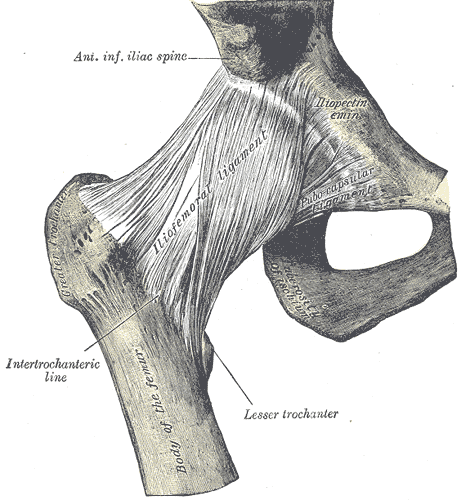
Gray's Anatomy (1918) plate, public domain
The hip is the deep ball-and-socket joint between the femur's head and the pelvis's cup (acetabulum). Unlike the shoulder, it is built for stability and load-bearing: the socket is deep, ringed by a cartilage labrum, and bound by the body's strongest ligaments, yet it still allows a wide range of movement. It transmits the entire upper body's weight to the legs with each step, withstanding forces of several times body weight.
Key facts
- The hip's socket faces sideways, forwards and slightly down, matching the femur's angled neck.
- The iliofemoral ligament at its front is the strongest ligament in the body and lets you stand with minimal muscle effort.
- The femoral head's blood supply runs up the neck — which is why neck fractures can starve the head of blood.
- A small artery in a ligament to the head contributes supply in childhood but little in adults.
What can go wrong
Osteoarthritis of the hip — cartilage wear causing groin pain and stiffness — is a leading reason for joint replacement, which reliably relieves it. Fractures of the femoral neck after falls in older people are a major health burden. In younger people, labral tears and shape mismatches (femoroacetabular impingement) cause groin pain, while childhood hip problems (such as Perthes disease and slipped epiphysis) need prompt recognition.
Related conditions
Related procedures & tests
Related symptoms
Related muscles
Frequently asked questions
Why does hip pain often feel like groin pain?
The joint sits deep in the groin crease and shares nerves with that region; buttock pain, by contrast, more often comes from the back or sacroiliac area.
What is a total hip replacement?
Surgery replacing the worn ball and socket with metal, ceramic and plastic components, relieving arthritic pain and restoring movement for most patients for many years.
Educational information only. This atlas explains normal anatomy and describes conditions in general terms; it is not medical advice and does not replace assessment by a qualified clinician. If you have symptoms that worry you, seek medical care.