
- Physical Examination
- Surgical Examination
- Ophthalmology
- Clinical Skills
- Orthopedics
- Surgery Videos
- Laparoscopy
- Pediatrics
- Funny Videos
- Cardiothoracic Surgery
- Nursing Videos
- Plastic Surgery
- Otorhinolaryngology
- Histology and Histopathology
- Neurosurgery
- Dermatology
- Pediatric Surgery
- Urology
- Dentistry
- Oncology and Cancers
- Anatomy Videos
- Health and Fitness
- Radiology
- Anaesthesia
- Physical Therapy
- Pharmacology
- Interventional Radiology
- Cardiology
- Endocrinology
- Gynecology
- Emergency Medicine
- Psychiatry and Psychology
- Childbirth Videos
- General Medical Videos
- Nephrology
- Physiology
- Diet and Food Health
- Diabetes Mellitus
- Neurology
- Women Health
- Osteoporosis
- Gastroenterology
- Pulmonology
- Hematology
- Rheumatology
- Toxicology
- Nuclear Medicine
- Infectious Diseases
- Vascular Disease
- Reproductive Health
- Burns and Wound Healing
- Kidney Zone Podcast
- Other
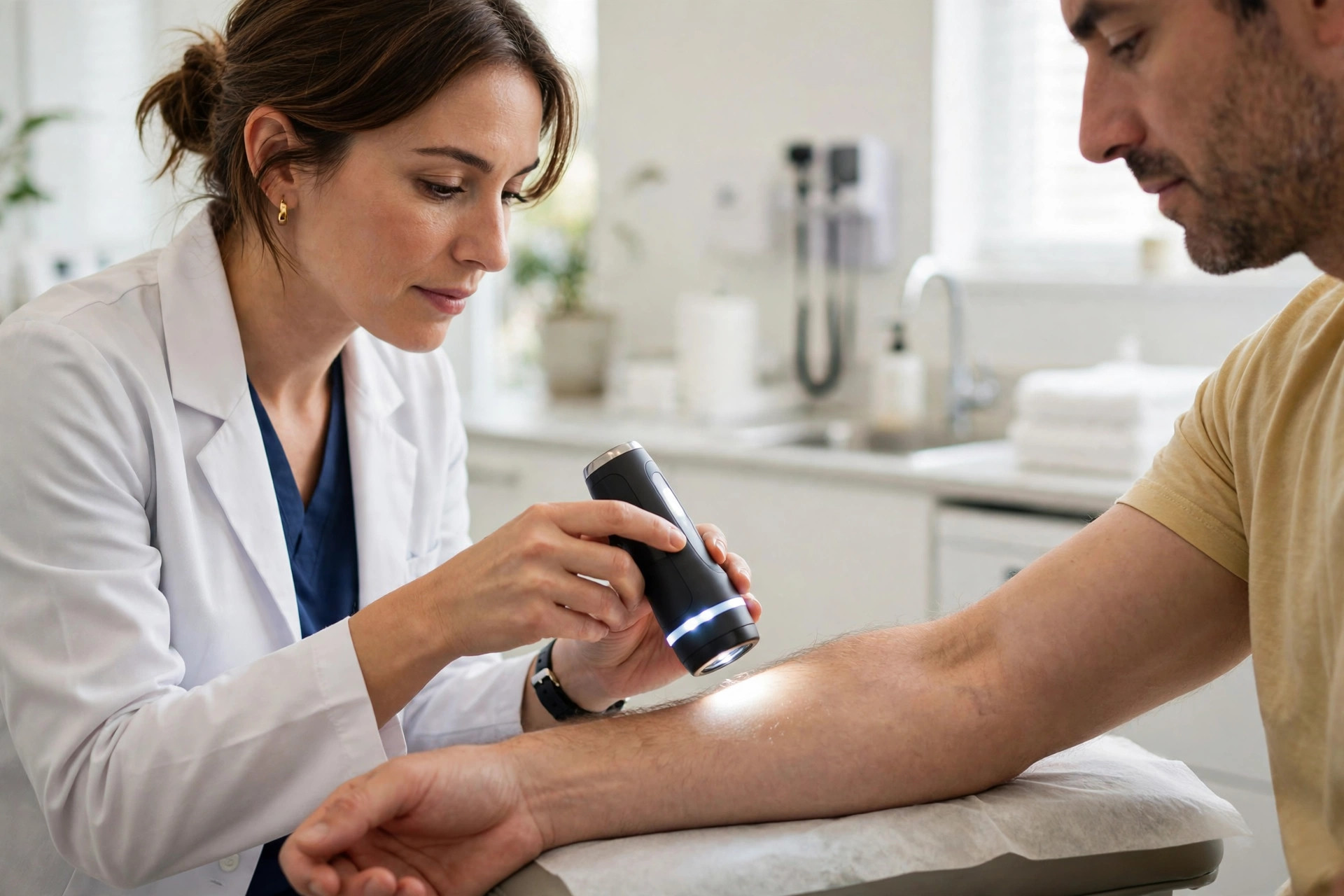
Chapter 12: Diseases of the skin and subcutaneous tissue (L00–L99)
Skin and tissue conditions: eczema and dermatitis, psoriasis, acne, skin infections such as cellulitis, pressure ulcers, urticaria (hives), and hair and nail disorders.
Chapter 12 spans codes L00–L99 in the FY2027 ICD-10-CM tabular list. This guide explains 29 of its most common codes — select a code for its official description, a plain-English explanation and a note on when the code is used.
Codes in this chapter
| Code | Official description | In plain words |
|---|---|---|
| L01.00 | Impetigo, unspecified | Impetigo is a contagious superficial skin infection, usually with honey-coloured crusts, common in children. |
| L02.91 | Cutaneous abscess, unspecified | A cutaneous abscess is a pocket of pus under the skin causing a painful, swollen lump; the site is not specified here. |
| L03.115 | Cellulitis of right lower limb | Cellulitis of the right lower leg: a spreading bacterial skin infection causing redness, warmth, swelling and pain. |
| L03.116 | Cellulitis of left lower limb | Cellulitis of the left lower leg: a spreading bacterial skin infection causing redness, warmth, swelling and pain. |
| L03.90 | Cellulitis, unspecified | Cellulitis is a bacterial infection of the skin and the tissues beneath it, causing spreading redness, pain and swelling. |
| L20.9 | Atopic dermatitis, unspecified | Atopic dermatitis (eczema) is a chronic itchy, inflamed skin condition linked to allergy and asthma, often starting in childhood. |
| L21.9 | Seborrheic dermatitis, unspecified | Seborrhoeic dermatitis causes scaly, flaky patches on the scalp (dandruff), face and chest, linked to skin yeasts. |
| L25.9 | Unspecified contact dermatitis, unspecified cause | Contact dermatitis is a skin reaction to something touching the skin; neither the type nor the cause is specified here. |
| L29.9 | Pruritus, unspecified | Pruritus means itching of the skin, recorded here without a specified cause or rash type. |
| L30.9 | Dermatitis, unspecified | Dermatitis means inflammation of the skin with itching, redness and scaling; the type is not specified here. |
| L40.0 | Psoriasis vulgaris | Psoriasis vulgaris (plaque psoriasis) is the commonest form of psoriasis: raised, red, scaly plaques on elbows, knees and scalp. |
| L40.9 | Psoriasis, unspecified | Psoriasis is a chronic immune-mediated skin condition causing rapid skin-cell turnover and scaly plaques. |
| L42 | Pityriasis rosea | Pityriasis rosea is a self-limiting rash of oval pink patches, often starting with a single larger 'herald' patch. |
| L43.9 | Lichen planus, unspecified | Lichen planus is an itchy, purple, flat-topped spotty rash affecting skin, mouth or nails; cause not specified here. |
| L50.9 | Urticaria, unspecified | Urticaria (hives) is an itchy, raised, blotchy rash caused by histamine release in the skin, often allergic. |
| L57.0 | Actinic keratosis | Actinic keratosis is a rough, scaly patch on sun-damaged skin that is precancerous and can occasionally become squamous cell carcinoma. |
| L60.0 | Ingrowing nail | An ingrowing nail is when the edge of a toenail grows into the surrounding skin, causing pain and sometimes infection. |
| L65.9 | Nonscarring hair loss, unspecified | Nonscarring hair loss means thinning or shedding of hair in which the follicles survive and regrowth is possible. |
| L70.0 | Acne vulgaris | Acne vulgaris is the common form of acne: blocked pores, spots and inflammation of the face, chest and back, mainly in teenagers. |
| L71.9 | Rosacea, unspecified | Rosacea is a chronic facial skin condition causing flushing, persistent redness, spots and visible blood vessels. |
| L72.0 | Epidermal cyst | An epidermal (epidermoid) cyst is a benign, slow-growing lump under the skin filled with keratin. |
| L73.2 | Hidradenitis suppurativa | Hidradenitis suppurativa is a chronic condition of painful, recurring boils and tunnels in skin folds such as the armpits and groin. |
| L82.1 | Other seborrheic keratosis | Seborrhoeic keratosis is a common benign, warty, 'stuck-on' skin growth of older adults. |
| L84 | Corns and callosities | Corns and callosities are areas of thickened hard skin caused by repeated pressure or friction, usually on the feet. |
| L85.3 | Xerosis cutis | Xerosis cutis is abnormally dry skin, common in older adults and in cold weather, causing roughness and itching. |
| L89.90 | Pressure ulcer of unspecified site, unspecified stage | A pressure ulcer (bedsore) is skin damage from prolonged pressure, here with site and depth not specified. |
| L91.8 | Other hypertrophic disorders of the skin | Other hypertrophic skin disorders include skin tags: small, soft, benign flaps of skin in folds such as the neck and armpits. |
| L97.909 | Non-pressure chronic ulcer of unspecified part of unspecified lower leg with unspecified severity | A non-pressure chronic ulcer of the leg: a long-standing open sore not caused by pressure, with site and depth unspecified. |
| L98.9 | Disorder of the skin and subcutaneous tissue, unspecified | A disorder of the skin or tissue beneath it recorded without further detail. |
This guide explains ICD-10-CM codes in plain language for patients, students and other readers. It is educational information only — not coding, billing or medical advice. The code recorded for any real encounter is assigned from the full clinical documentation by the treating team and qualified coders, and only they can decide which code fits a specific case.
Other chapters
- Chapter 1: Infectious & Parasitic Diseases
- Chapter 2: Neoplasms
- Chapter 3: Blood & Immune Disorders
- Chapter 4: Endocrine, Nutritional & Metabolic
- Chapter 5: Mental, Behavioral & Neurodevelopmental
- Chapter 6: Nervous System
- Chapter 7: Eye & Adnexa
- Chapter 8: Ear & Mastoid Process
- Chapter 9: Circulatory System
- Chapter 10: Respiratory System
- Chapter 11: Digestive System
- Chapter 13: Musculoskeletal & Connective Tissue
- Chapter 14: Genitourinary System
- Chapter 15: Pregnancy, Childbirth & Puerperium
- Chapter 16: Perinatal Period
- Chapter 17: Congenital & Genetic Disorders
- Chapter 18: Symptoms, Signs & Abnormal Findings
- Chapter 19: Injury & Poisoning
- Chapter 20: External Causes of Morbidity
- Chapter 21: Factors Influencing Health Status
- Chapter 22: Codes for Special Purposes